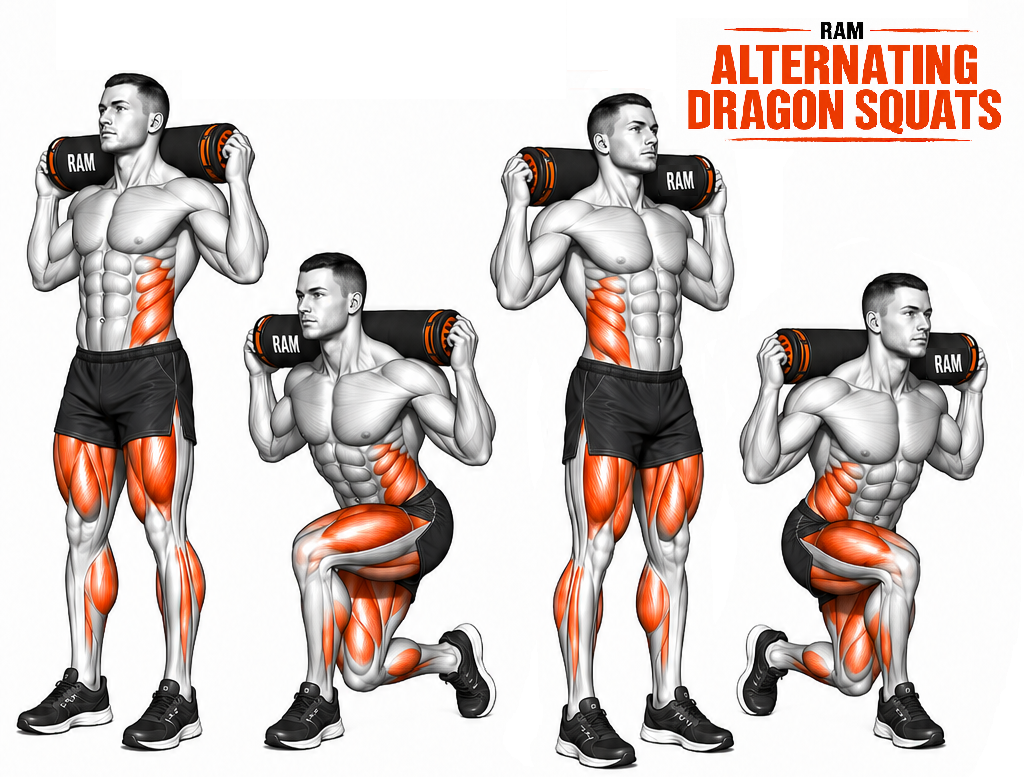
RAM Alternating Dragon Squats
A cross-behind dragon squat alternating sides while holding the RAM, demanding single-leg strength, balance and hip control.
Level: Advanced
Primary: Quads
Secondary: Glutes Hamstrings
Movement: Compound
Tags: Squat Unilateral
Type: Functional Fitness (Obstacle & Hybrid) Strength (Weight Lifting)
Equipment: RAM
Target muscles
The dragon squat sweeps one leg behind and across the body, loading the working-leg quad and glute through a deep, rotated range while the inner thigh and hip stabilisers control the diagonal path. Alternating sides with the RAM held at the chest adds load and a constant balance and core demand. It's an advanced single-leg pattern that builds strength in a challenging position.
How to perform
Setup
Hold the RAM at the chest by the handles, standing tall on one leg with the other ready to sweep behind, core braced.
Execution
Sweep one leg back and across behind the standing leg, bending the standing knee to lower into a deep curtsy-style squat, keeping the chest up and the RAM stable. Drive back up through the standing leg to stand tall, then alternate the sweeping leg on the next rep. Move under control — the crossed-behind position is where balance is most tested. Keep the front knee tracking over the foot, not caving in.
Common mistakes
- Letting the standing knee collapse inward in the deep rotated position.
- Pitching the torso forward and losing the upright RAM position.
- Rushing the sweep and losing balance instead of controlling the descent.
- Shallow reps that skip the deep range where the movement earns its value.
Progressions and regressions
Regress to a bodyweight curtsy lunge or a standard reverse lunge to build the pattern and balance. Progress by increasing RAM load, slowing the descent, or pausing at the bottom. Master the unloaded movement before adding the bar.
Programming notes
Program it as a single-leg strength and stability builder, 3 sets of 6-10 per side. It targets the glutes and adductors in a way straight-ahead lunges miss and exposes side-to-side weaknesses. Use it as accessory work after a bilateral squat or hinge.