Chair Pose
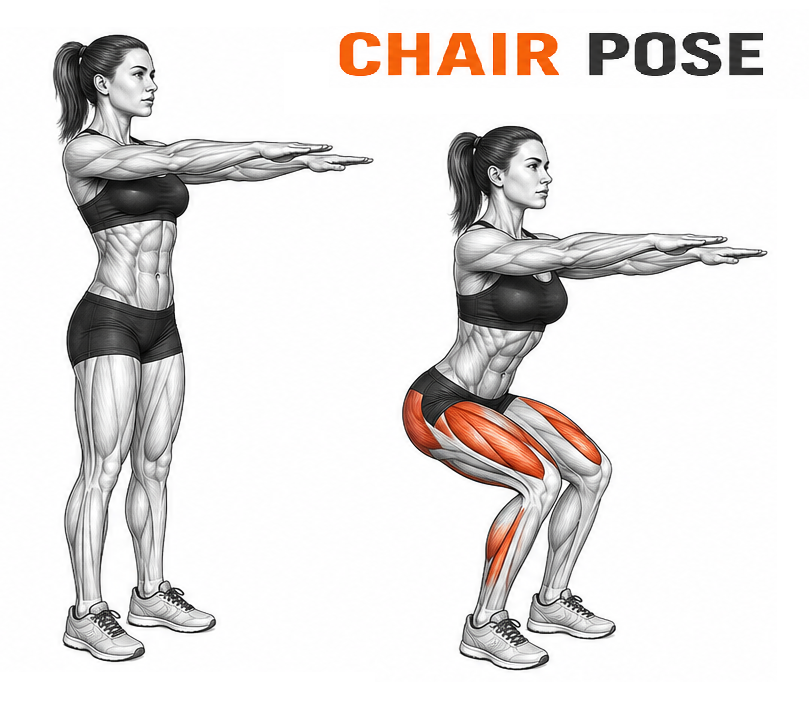
The yoga utkatasana — an isometric squat hold with the arms reaching overhead that builds quad endurance and shoulder mobility.
Level: Beginner
Primary: Quads
Secondary: Abs Glutes
Movement: Compound
Tags: Squat
Type: Flexibility (Dynamic Stretching) ISO
Equipment: Body Weight
Target muscles
The quadriceps work isometrically to hold the partial squat, building tension endurance rather than moving a load. The gluteus maximus supports hip flexion at depth, the calves and ankle stabilisers keep you balanced, and the erector spinae and abdominals brace to hold the long spine. Reaching the arms overhead adds a stretch through the lats and a stability demand at the shoulders, so the pose trains the legs and the upper body at once.
How to perform
Setup
Stand with feet hip-width or together, weight back toward the heels. Take a breath and lift both arms overhead, biceps by the ears, palms facing each other or together. Lengthen the spine before you begin to sink.
Execution
Bend the knees and sit the hips back and down as though lowering toward a chair, keeping the chest lifted and the weight in the heels so the knees stay behind or over the toes. Reach the arms up and slightly back, drawing the shoulder blades down away from the ears. Hold the position and breathe steadily into the brace, keeping the lower back long rather than over-arched. The quads should burn as they hold; resist the urge to rise up and relieve them. Keep the gaze forward and the breath calm for the duration of the hold.
Common mistakes
- Shifting weight onto the toes so the knees drift far past them and the heels lift.
- Over-arching the lower back instead of bracing the abs to keep a long, neutral spine.
- Letting the shoulders shrug up to the ears rather than drawing the blades down.
- Rising out of the squat to escape the quad burn instead of holding the set depth.
Progressions and regressions
Regress by sitting less deeply, resting the back against a wall in a wall-sit, or bringing the hands to the chest to ease the shoulder demand. Progress by sinking deeper toward a parallel squat, holding longer, or adding a light weight in the hands. Rising onto the balls of the feet introduces a balance challenge for a more advanced hold.
Programming notes
Use it as quad-endurance and mobility work, three to four holds of twenty to forty-five seconds, often inside a yoga flow or a warm-up. It is gentle on the joints and easy to scale, which makes it useful for beginners and active recovery. As an isometric it builds tension tolerance rather than strength or size, so treat it as a complement to, not a replacement for, loaded squatting.