Mini Trampoline Front Kick Bounce
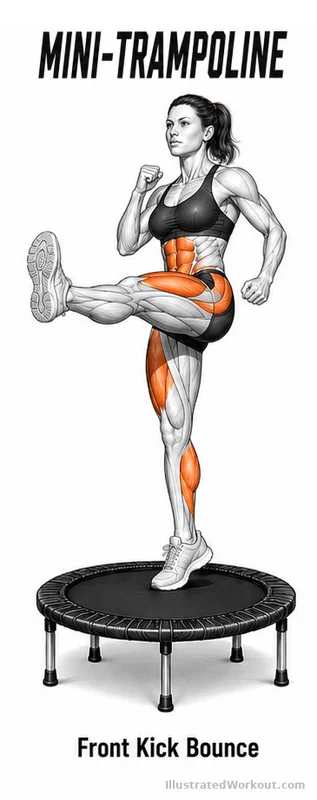
Alternating front kicks off a soft rebounder, extending each leg forward in rhythm to raise the heart rate and switch on the hip flexors.
Want a mini trampoline conditioning workout?
Our wizard builds one around your time, goal, and equipment in about two minutes. Free — no signup needed.
Make Me a Workout → Just did it? Track your setsAlternating front kicks off a soft rebounder, extending each leg forward in rhythm to raise the heart rate and switch on the hip flexors.
Level: Foundation
Primary: Cardio
Secondary: Abs Quads
Movement: Isolation
Type: Aerobic (Cardio)
Equipment: Mini Trampoline
Target muscles
The hip flexors and quadriceps drive each leg forward and straighten the knee to snap the kick out, while the standing leg's calf and glute stabilise the brief single-leg contact. The abdominals brace to keep the torso from rocking back as the leg extends, and the hamstrings control the return. The steady kick-and-rebound rhythm keeps the cardiovascular system working while the mat cushions each landing.
How to perform
Setup
Stand near the centre of the mat with feet hip-width, knees soft and hands up in a light guard. Bring the weight onto the balls of the feet and brace the trunk so the chest stays upright. Fix your gaze forward to help balance as you begin bouncing.
Execution
Bounce lightly and extend one leg forward into a controlled front kick to about hip height, then bring it back as you rebound and kick with the other leg. Keep the kicks controlled rather than snapping the knee to full lock-out, and let the core hold the torso upright instead of leaning back to reach higher. Stay over the middle of the mat and keep the standing foot's contact soft. Maintain an even, alternating rhythm and breathe steadily, driving each kick from the hip flexor with the quad finishing the extension.
Common mistakes
- Leaning the torso back to reach a higher kick instead of bracing the abs and keeping height honest.
- Snapping the knee into a hard lock-out, which stresses the joint over many reps.
- Losing balance by drifting off the mat's centre onto the frame.
- Letting the standing knee stiffen so landings jar rather than absorb into the mat.
Progressions and regressions
Regress by lowering the kick height and slowing the tempo, or holding a stability bar for balance while you learn the pattern. Progress by raising the kick height as mobility allows, quickening the cadence, or adding a light arm punch with the opposite hand to turn it into a fuller kickboxing-style bounce.
Programming notes
Use it as a warm-up that opens the hips and raises the heart rate, or as a station in a low-impact rebounder circuit, forty-five to sixty seconds per bout. It blends balance, hip mobility and cardio in one move, so it suits general fitness and older trainees well. Keep the kicks controlled rather than forceful; those chasing power should choose a dedicated kicking drill instead.