Mace 10 to 2
The deltoids and rotator cuff control a steel mace as it tilts behind the shoulders and is pulled back up — the foundational mace swing.
Level: Intermediate
Primary: Shoulder
Secondary: Abs Back - Upper Forearms
Movement: Compound
Tags: Rotational
Type: Flexibility (Dynamic Stretching) Functional Fitness (Obstacle & Hybrid)
Equipment: Mace
Target muscles
Because all the mace's weight sits at the far end of a long handle, the deltoids, rotator cuff and upper-back muscles work hard to control the offset torque as the head tips back over the shoulders. The forearms and grip resist the lever trying to pry the handle open, the traps and rhomboids stabilise the shoulder blades, and the obliques and deep core brace to stop the trunk twisting as the load travels behind the head. The further the head drops, the steeper the demand.
How to perform
Setup
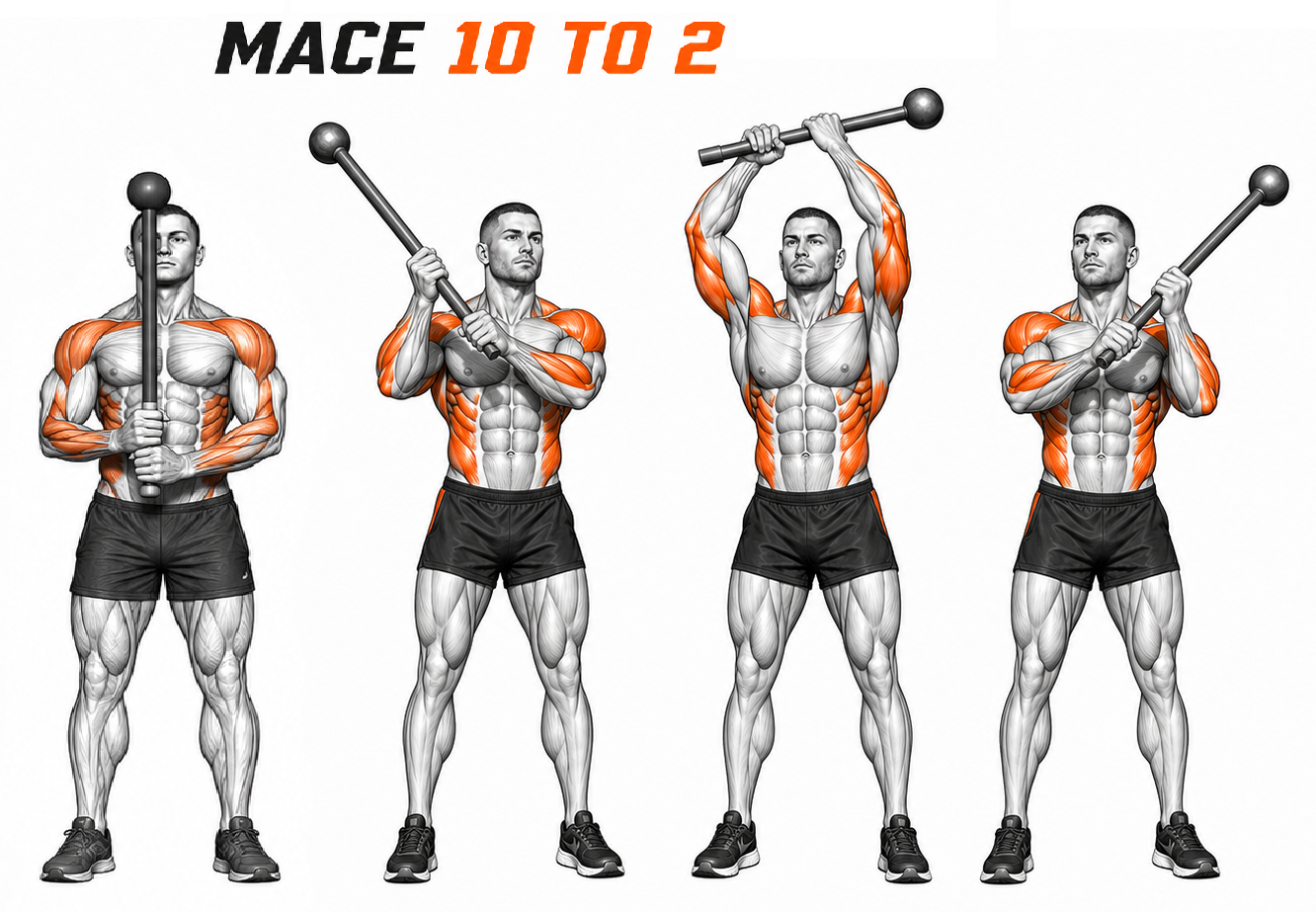
Hold the mace vertically at the chest in a front rack, both hands stacked near the bottom of the handle, the head pointing skyward. Stand tall, feet hip-width, knees soft, ribs down and core braced. Set the shoulders down and back before the first rep.
Execution
Let the mace tilt backward over one shoulder, lowering the head behind you toward the "10 o'clock" position as the elbows bend and travel up. Keep the handle close to the body and the head under control the whole way — never let it free-fall. When the head reaches the bottom of its arc, pull through the upper back and shoulders to bring it back up the same path to the front rack, finishing at "2 o'clock" on the other side. Move slowly and own every inch of the offset load; the goal is shoulder and grip control, not range or speed.
Common mistakes
- Letting the mace head free-fall behind the head, which dumps the load onto the shoulder joint and rotator cuff.
- Flaring the ribs and arching the lower back to counter the weight instead of bracing the core.
- Holding the handle too far up its length, shortening the lever and removing the point of the drill.
- Rushing the tilt-and-pull so momentum, not the upper back, moves the mace.
Progressions and regressions
Regress with a lighter mace or a shorter handle position so the offset torque stays manageable, or limit how far the head drops behind the shoulders. Progress by lengthening the lever toward the very bottom of the handle, slowing the tempo, or pausing at the bottom of the arc. The 10-to-2 is the gateway to the mace 360 and full rotational flows, so own it before chasing the bigger circles.
Programming notes
Program it as shoulder-prep or skill work, 2-3 sets of 8-12 controlled swings, early in a session when the shoulders are fresh and attentive. It builds the offset-load shoulder control and grip endurance that the rest of mace training relies on, and pairs well with overhead pressing as accessory stability work. Keep the load light — quality of the path beats grinding heavy reps here.