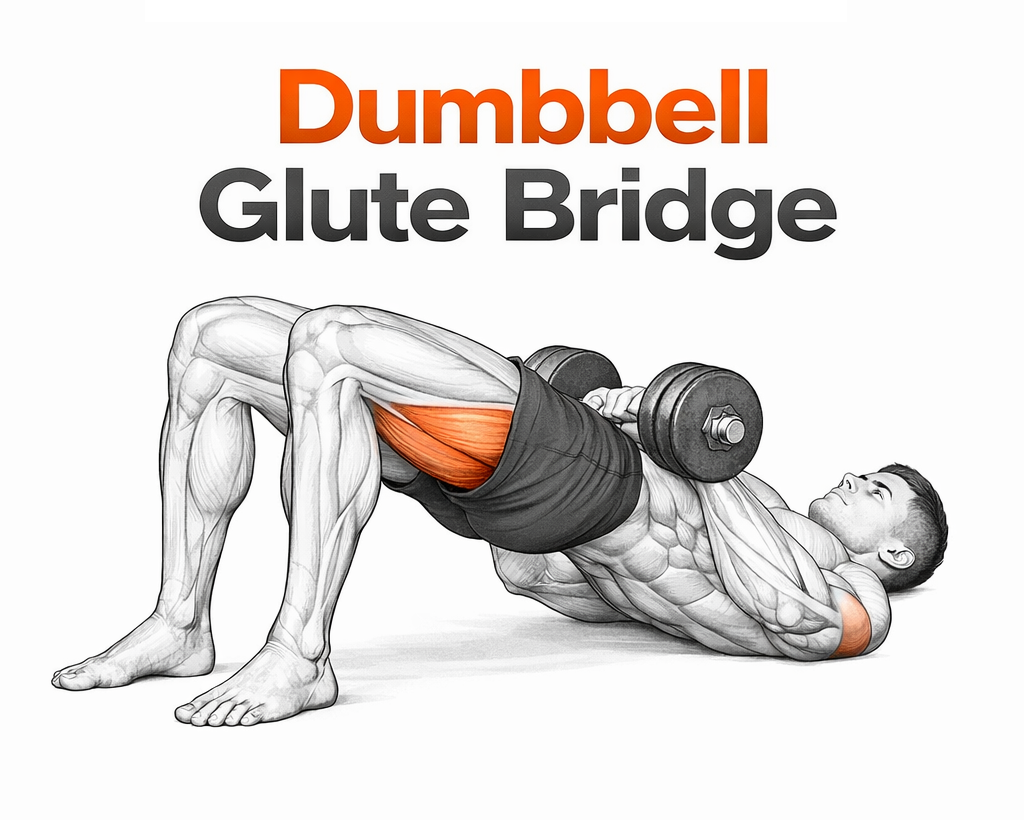
Dumbbell Glute Bridge
Glute bridge with a dumbbell loaded on the hips — fundamental hip extension with progressive overload through dumbbell weight.
Level: Advanced
Primary: Glutes
Secondary: Hamstrings
Movement: Compound
Tags: Hinge
Type: Light Activity Strength (Weight Lifting)
Equipment: Dumbbell
Sports: Football Running Soccer
Target muscles
The gluteus maximus drives hip extension against the dumbbell's load. The hamstrings co-contract. The trunk braces against the load on the hips. The dumbbell adds resistance without requiring the bench-and-barbell setup of a full hip thrust — making this a useful intermediate step between bodyweight glute bridges and loaded barbell hip thrusts. The lower back stabilizers fire continuously to keep the lumbar from collapsing into hyperextension at the top.
How to perform
Setup
Lie on your back with knees bent, feet flat on the floor at hip-width, heels close enough to your hips that at the top of the lockout the shins will be vertical. Place a dumbbell vertically on your lower abdomen and grip it lightly with both hands to keep it from sliding. Trunk braced.
Execution
Drive through the heels to lift the hips toward the ceiling, pushing the body into a straight line from shoulders to knees. Squeeze the glutes hard at the top for a one-second peak contraction. Lower the hips back to just above the floor under control. The chin tucks slightly at the top; an extended neck pulls the lumbar into hyperextension. The dumbbell stays stable on the lower abdomen throughout.
Common mistakes
- Hyperextending the lower back at the top instead of extending the hips. Tuck the chin and squeeze the glutes.
- Pushing off the toes. Drive through the heels.
- Letting the knees collapse inward. Push them out actively.
- Loading too heavy. A medium dumbbell (20-40 pounds) is enough for most lifters; if the dumbbell rolls off, it's too light or the brace is wrong.
- Pumping reps with no top squeeze. The peak contraction is most of the value.
Progressions and regressions
Regress to bodyweight glute bridges until the pattern is solid. To progress, work pause glute bridges (3-second hold at the top), then move to dumbbell hip thrusts (with bench support) for more loadable hip extension, and eventually to loaded barbell hip thrusts.
Programming notes
Excellent glute-activation warm-up or accessory work. 3-4 sets of 12-20 reps. Two or three times a week. Use as a warm-up before squat or deadlift sessions, or as accessory work in a glute-focused program. The dumbbell glute bridge is a useful stepping stone between bodyweight and loaded barbell hip extension work.