Dumbbell Curls
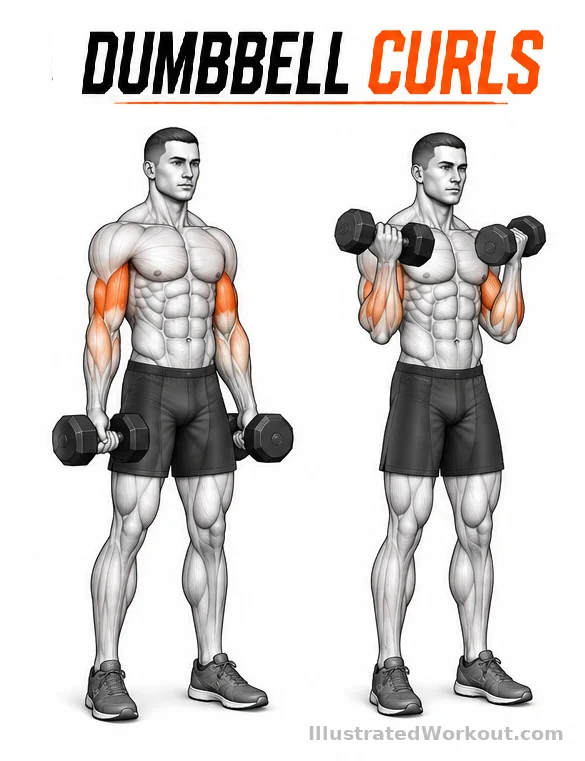
The standard standing biceps curl: both dumbbells lifted together with palms up, building the biceps and the elbow flexors underneath them.
Want a dumbbell arm workout?
Our wizard builds one around your time, goal, and equipment in about two minutes. Free — no signup needed.
Make Me a Workout → Just did it? Track your setsThe standard standing biceps curl: both dumbbells lifted together with palms up, building the biceps and the elbow flexors underneath them.
Level: Beginner
Primary: Biceps
Secondary: Forearms
Movement: Isolation
Tags: Pull
Type: Strength (Weight Lifting)
Equipment: Dumbbell
Target muscles
Both heads of the biceps brachii flex the elbow and, because the palms stay turned up, also hold the forearm in supination, which is the position where the biceps is strongest. Underneath it the brachialis contributes a large share of the pulling force and adds thickness to the upper arm. The brachioradialis and the wrist flexors of the forearm assist and keep the grip closed around the handles. The front deltoids, upper back and abdominals work isometrically to hold the shoulders and torso still, so the elbows stay the only joints that move.
How to perform
Setup
Stand with your feet about hip width apart and a dumbbell in each hand, arms hanging straight at your sides. Turn your palms to face forward and grip the handles firmly with the wrists straight. Lift your chest, draw your shoulders back and down, and tighten your abs and glutes so the torso cannot rock. Pin your elbows lightly against your ribs; that is where they stay for the whole set.
Execution
Exhale and curl both dumbbells upward by bending only at the elbows, keeping the upper arms vertical and the palms facing up. Continue until the forearms are just past vertical and the biceps are fully shortened, without letting the elbows drift forward to rest the weight on the shoulders. Squeeze for a moment at the top. Inhale and lower over two to three seconds until the arms are completely straight again, since the bottom third of the range is where most people cut the rep short. Keep the wrists neutral throughout and start each rep from a dead hang, with no swing from the hips.
Common mistakes
- Leaning back and swinging the hips to start the weight moving, which shifts the load to the lower back and takes tension off the biceps.
- Letting the elbows travel forward as the dumbbells rise, so the front deltoids finish the rep and the biceps rest at the top.
- Stopping short of a straight arm on the way down, which skips the lengthened part of the range and limits growth.
- Curling the wrists toward the forearms, which tires the grip first and often irritates the inside of the elbow.
Progressions and regressions
If strict reps are hard to hold, stand with your back and head against a wall, or sit on a bench, to take the hips out of the movement. Alternating arms lets you concentrate on one side at a time with the same weight. To progress, slow the lowering phase to four seconds, add a pause at ninety degrees, or move to the incline dumbbell curl, which loads the biceps in a deeper stretch. Hammer curls and Zottman curls shift more of the work to the brachialis and forearms once the standard curl is solid.
Programming notes
Two to four sets of eight to fifteen reps works well, taken close to failure with clean form; very heavy sets under six reps tend to turn into swinging. Place curls after rows, pulldowns or pull-ups, which already train the biceps hard, or pair them with a triceps exercise as a superset on an arm day. Two sessions a week is plenty for most people. Skip direct curls on a day when heavy pulling has left the elbows sore, and choose a weight you can lower as slowly as you lift it.