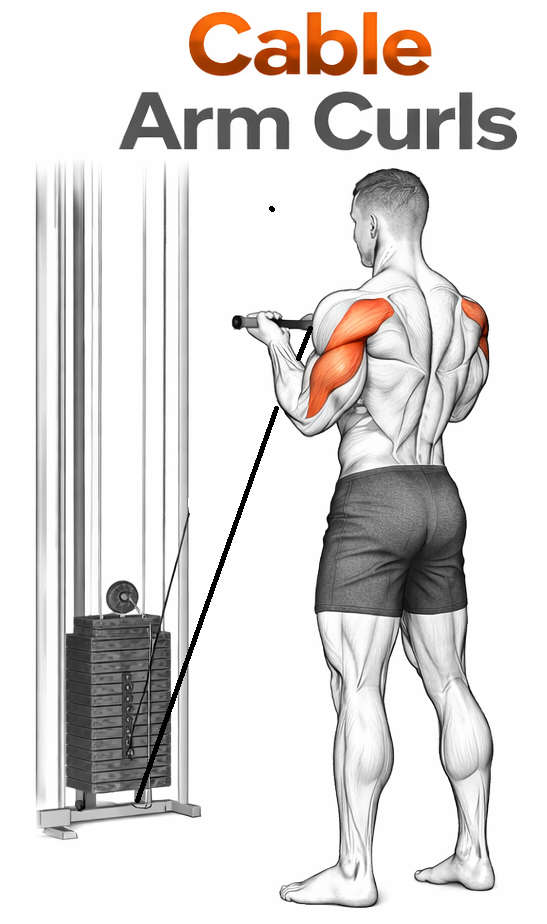
Cable Arm Curls
Standing cable curl with constant tension through the full range — smoother loading than a barbell, no dead spot at the top of the rep.
Level: Beginner
Primary: Biceps
Movement: Isolation
Tags: Pull
Type: Strength (Weight Lifting)
Equipment: Cable
Sports: Baseball Wrestling
Target muscles
The biceps brachii is the prime mover, working through full elbow flexion against constant tension. The brachialis underneath contributes through the lower half of the rep. The brachioradialis assists, particularly with a wider grip. What makes the cable version different from a barbell curl is the constant resistance: a barbell loses tension at the top of the rep (when gravity pulls straight down through the bar), but a cable maintains tension through the entire arc because of its angled pulley path. That extra time under tension matters for hypertrophy.
How to perform
Setup
Set a cable to the lowest pulley with a straight bar or EZ-curl bar attachment. Stand facing the machine about two feet back, feet hip-width apart. Grip the bar with an underhand grip slightly wider than shoulder-width. Elbows pinned to the sides. Stand tall, chest up, slight knee bend.
Execution
Curl the bar up by flexing at the elbows only. The upper arms shouldn't drift forward as the bar rises. Squeeze the biceps hard at peak contraction — the cable will pull harder at the top than a barbell would, so use that tension. Lower the bar over a count of two to three to fully extended; don't slam through the negative or let the cable pull your arms straight down too fast. Throughout the set, the upper arms stay vertical — they don't rock forward or back.
Common mistakes
- Letting the cable pull your arms straight too quickly on the descent. Resist the eccentric — that's where the biceps grow.
- Standing too close or too far from the cable. Two feet back is the sweet spot for most lifters; too close cuts the bottom range, too far reduces the top range.
- Curling with the upper arms drifting forward. Pin the elbows to your sides.
- Swinging the torso to start the rep. The body stays still; only the elbows bend.
- Using a thumbless grip. Wrap the thumbs around the bar.
Progressions and regressions
Regress to dumbbell curls if the cable feels foreign. To progress, work pause curls (3-second pause at peak contraction), drag curls (cable hugs the body as it rises), 21s (seven half-reps bottom, seven half-reps top, seven full), or single-arm cable curls for unilateral focus.
Programming notes
Accessory work after the main pulling movements. 3-4 sets of 8-12 reps. Two or three times a week. The constant tension of cable curls is particularly useful as a finisher after barbell or dumbbell curls; the abs of variation in the loading profile fatigues the biceps differently and extends the workout's hypertrophy stimulus.