Disc Slider Push-Up Reaches
Each push-up ends with one hand sliding forward to full reach, hammering the chest while the core resists the twist of the offset load.
Want a disc sliders chest workout?
Our wizard builds one around your time, goal, and equipment in about two minutes. Free — no signup needed.
Make Me a Workout → Just did it? Track your setsEach push-up ends with one hand sliding forward to full reach, hammering the chest while the core resists the twist of the offset load.
Level: Advanced
Primary: Chest
Secondary: Abs Shoulder Triceps
Movement: Compound
Tags: Push
Type: Functional Fitness (Obstacle & Hybrid) Strength (Weight Lifting)
Equipment: Disc Sliders
Target muscles
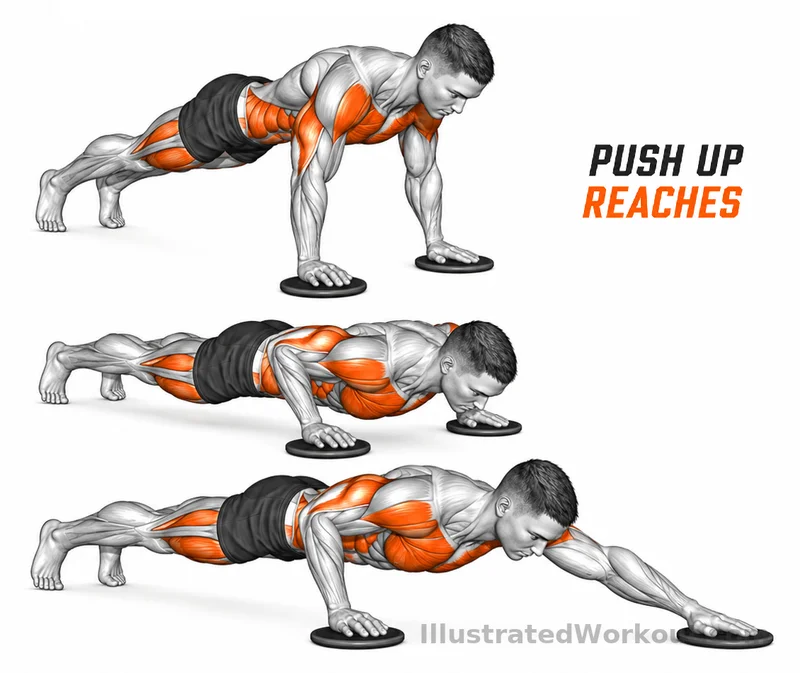
Pressing the body up rests on the pectorals and triceps of the planted arm while one hand slides forward into a long reach. As that arm extends, the lats and serratus lengthen, and the entire trunk, especially the obliques and rectus abdominis, works overtime to resist the rotation and forward pull created by the offset limb. The glutes stay tight to keep the hips level.
How to perform
Setup
Take a high plank with a slider under each hand, hands under the shoulders and body braced in a straight line. Set the feet slightly wider than usual for extra anti-rotation stability. Draw the shoulders down and pack the abs so the pelvis does not tip when one hand leaves its position.
Execution
Perform a push-up, and at the top slide one hand forward until the arm reaches long in front of the shoulder, then draw it back and repeat on the other side. Keep the hips square to the floor as the hand travels; the strong resistance to twisting is the point. Move slowly and deliberately, exhaling as you reach and keeping the supporting elbow soft. Alternate hands each rep, or complete a push-up between reaches for more chest work. Keep the neck long and the gaze just ahead of the hands.
Common mistakes
- Letting the hips rotate open toward the reaching arm instead of bracing the obliques to keep them square.
- Shrugging the supporting shoulder up to the ear rather than keeping it packed down and stable.
- Reaching only a short distance, which removes the long-lever core demand the drill is built on.
- Rushing the hand back so the plank shifts and the low back dips between reps.
Progressions and regressions
Regress by performing the reach from the knees, or by reaching without a preceding push-up until the anti-rotation control is solid. A narrower reach shortens the lever for beginners. Progress by reaching further, pausing at full extension, or adding a slow push-up between every reach. Elevating the feet or adding a light forward slide of the same-side foot raises the total-body demand considerably.
Programming notes
Slot it into push or full-body sessions as a core-and-chest combination, five to eight reaches per side for two to three sets. It doubles as anti-rotation training, so it fits well in circuits alongside carries and planks. Keep the reps slow and controlled; speed hides the rotation the movement is meant to resist, and stop if the shoulder of the supporting arm fatigues into a shrug.