Decline Push ups
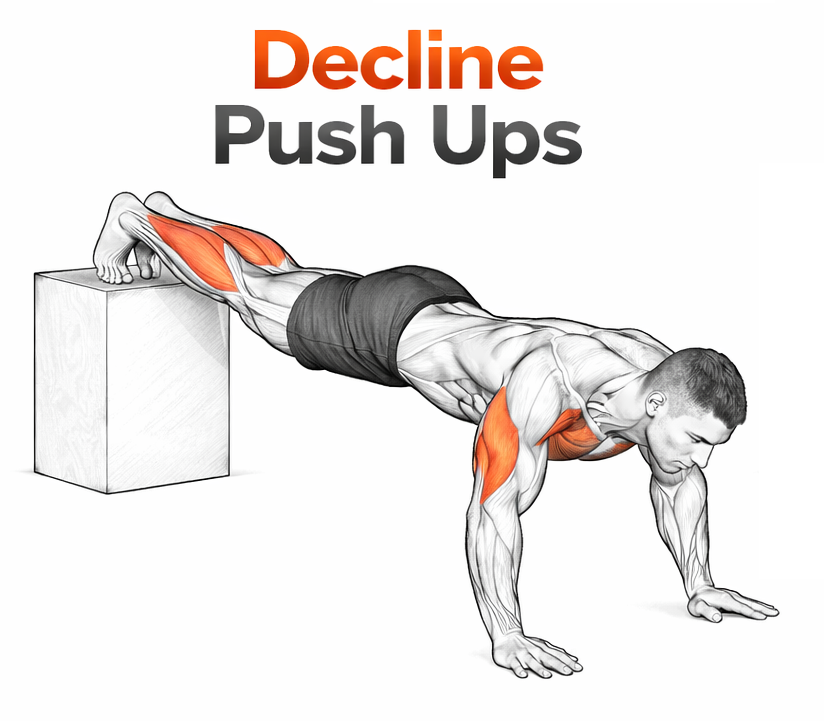
Push-up with the feet on a raised surface — shifts the work to the upper chest and front delts through a steeper press angle.
Level: Foundation
Primary: Chest
Secondary: Shoulder Triceps
Movement: Compound
Tags: Push
Type: Functional Fitness (Obstacle & Hybrid)
Equipment: Jump Box
Sports: Football Gymnastics MMA Wrestling
Target muscles
The clavicular (upper) head of the pectoralis major takes more of the work thanks to the elevated foot position — the press now travels at an angle closer to an incline bench press than a flat one. The anterior deltoid contributes more than in a standard push-up. The triceps brachii lock out the elbows. The serratus anterior holds the scapulae stable. The trunk braces against the angled body weight; trunk demand actually rises as the feet go higher because the head-down position requires more anti-extension work from the abs.
How to perform
Setup
Place your feet on an elevated surface — a sturdy bench, box, or chair, anywhere from 6 inches up to two feet tall depending on the angle you want. Higher elevation, more upper-pec and front-delt emphasis. Hands flat on the floor slightly wider than shoulder-width. Body in a straight line from heels through head. Trunk braced, glutes squeezed.
Execution
Lower the chest toward the floor by bending the elbows — they should tuck at about 45 degrees from the torso, not flare wide. The chest touches or nearly touches the floor at the bottom. Pause briefly. Press back up to full elbow lockout. The body forms a straight line throughout — hips don't sag, glutes stay squeezed, head stays in line with the spine. Slow controlled tempo, especially on the descent.
Common mistakes
- Sagging hips. The body line breaks; brace the trunk and squeeze the glutes.
- Elbows flaring out to 90 degrees. Tuck them at about 45 degrees.
- Cutting the range — not lowering the chest fully. Touch the floor or come within an inch.
- Going too steep too early. Start at six inches of elevation; build over weeks.
- Letting the head drop or hyperextend. The neck stays neutral; gaze on the floor between the hands.
Progressions and regressions
Regress to standard push-ups (feet on the floor) until you can do twelve clean reps. Then to a low elevation (6 inches) for declines. To progress, raise the foot elevation, add a weighted vest, or work toward handstand push-ups for the ultimate vertical-press progression.
Programming notes
Excellent at-home upper-chest builder. 3-4 sets of 8-15 reps, two or three times a week. Pair with rowing volume to balance the pressing work. As the strength builds, progressively raise the foot elevation rather than just chasing more reps — the angle increase shifts the loading toward more vertical pressing, which is what carries over to overhead pressing strength.