Disc Slider Burpees
A slider burpee glides the feet back to a plank and in again instead of jumping, spiking the heart rate while sparing the joints from impact.
Want a disc sliders conditioning workout?
Our wizard builds one around your time, goal, and equipment in about two minutes. Free — no signup needed.
Make Me a Workout → Just did it? Track your setsA slider burpee glides the feet back to a plank and in again instead of jumping, spiking the heart rate while sparing the joints from impact.
Level: Intermediate
Primary: Cardio
Secondary: Abs Chest Quads
Movement: Compound
Tags: Explosive
Type: Anaerobic Intervals (HIIT / Bootcamp / Circuit) Functional Fitness (Obstacle & Hybrid)
Equipment: Disc Sliders
Target muscles
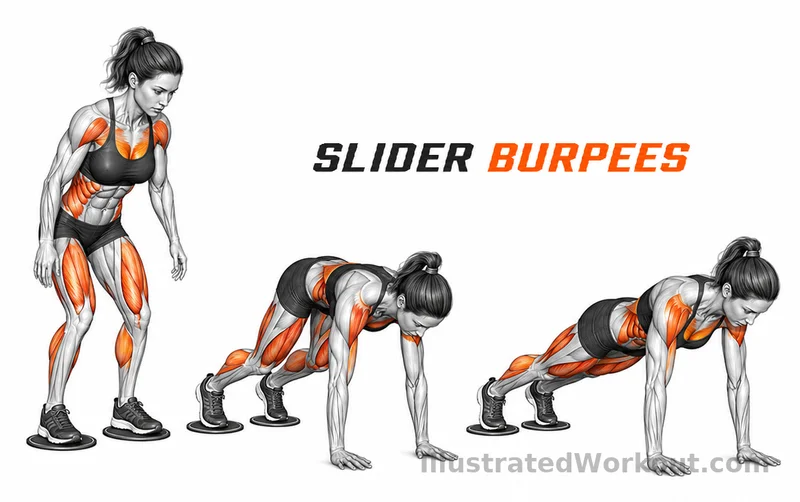
Driving a full burpee cycle with the feet on sliders hits nearly everything. The quads and glutes power the stand-up and the tall reach, the chest, shoulders and triceps handle the plank and any push-up, and the abs and hip flexors pull the feet back in under control. Because the sliders let the legs shoot back and return smoothly, the demand becomes continuous rather than a series of impacts, which keeps the cardiovascular system working hard throughout.
How to perform
Setup
Stand with a slider under each foot on a smooth floor, feet hip-width and the core braced. Keep the weight balanced over the mid-foot so the discs do not shoot out prematurely. Set the shoulders down and back and pick a fixed point ahead to keep the torso honest.
Execution
Hinge and place the hands on the floor, then glide both feet back into a straight plank instead of jumping them. Hold the plank tight for a beat, add a push-up if you want more, then slide the feet back in toward the hands. Stand tall and reach overhead or add a small hop to finish the rep, then flow straight into the next. Keep the transitions smooth and the core braced so the hips never sag as the feet travel back and forth.
Common mistakes
- Letting the hips pike or sag when the feet slide back rather than landing in a solid plank.
- Rushing the slide-in so the discs skid out sideways and the knees collapse inward.
- Rounding the lower back on the hinge down instead of keeping the spine long.
- Losing the brace at the top and flopping into the next rep with no control.
Progressions and regressions
Regress by removing the push-up, stepping one foot back at a time, or slowing the pace to groove the pattern. A standing squat-thrust without the overhead reach is an easier entry point. Progress by adding the push-up plus a jump at the top, piking the hips on the slide-in for a knee-tuck finish, or shortening the rest between reps to raise the conditioning stimulus.
Programming notes
Use it as low-impact interval conditioning, thirty to forty-five seconds of continuous reps or sets of eight to fifteen inside a circuit. The sliders make it kinder on the wrists and knees than a jumping burpee, so it suits people who need volume without the pounding. Keep the plank rigid as fatigue climbs, and cut the set short before form collapses rather than grinding sloppy reps.