Chin Ups
Underhand-grip pull-up — pulls the chin over a bar with the biceps doing more work and the lats less than in a standard pull-up.
Level: Beginner
Primary: Back - Upper Biceps
Movement: Compound
Tags: Pull
Type: Functional Fitness (Obstacle & Hybrid) Strength (Weight Lifting)
Equipment: Pull-Up Bar
Sports: Gymnastics Rock Climbing Wrestling
Target muscles
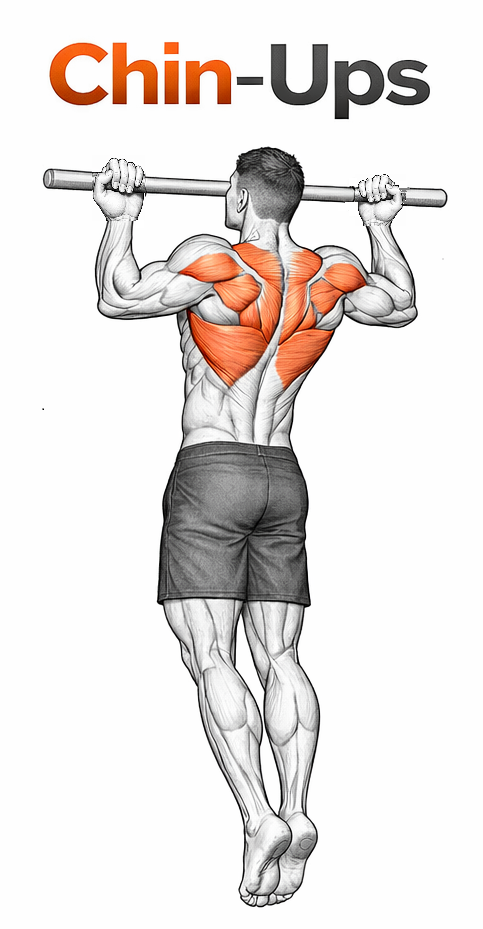
The latissimus dorsi drive shoulder extension. The biceps brachii and brachialis contribute significantly more than in a pronated pull-up — the supinated grip puts the biceps in its strongest position. The rhomboids and middle trapezius retract the scapulae. The rear deltoids contribute. The pectoralis major (sternal portion) assists with shoulder extension. The forearms, grip, and trunk all work isometrically. Chin-ups are often a strong man's exercise — many lifters can chin themselves to a bar before they can pull-up, because the biceps assistance is so prominent.
How to perform
Setup
Hang from a pull-up bar with an underhand (supinated) grip, hands roughly shoulder-width apart. Arms fully extended. Shoulders pulled down and back from the start — actively pack them rather than hanging loose. Slight crossing of the legs at the ankle for trunk stability. Brace the trunk; squeeze the glutes lightly.
Execution
Pull yourself up by driving the elbows down and back, finishing with the chin clearly over the bar. The chest rises toward the bar; the shoulder blades retract at the top. Pause briefly at the peak contraction. Lower yourself under control through the full range, ending at a clean dead hang with the shoulders still packed (not loose). The eccentric matters — three seconds down on every rep. Don't kip or swing for momentum; if the rep needs momentum, the load is too heavy.
Common mistakes
- Kipping the hips to launch the body. Strict chin-ups have no swing. If you want to train kipping, that's a separate skill.
- Stopping at "neck-height" instead of clearing the chin over the bar. Pull through full range.
- Dropping out of the rep at the bottom — going limp at the dead hang. Stay packed at the bottom; the shoulders should never go fully passive.
- Same-grip-width every set forever. Vary grip width occasionally to hit the back differently — close grip emphasizes the biceps more; wider grip shifts toward the lats.
- Counting half-reps. If the chin doesn't clear, it's not a rep.
Progressions and regressions
Regress to assisted chin-ups (band looped around the bar and under one knee, or assisted-pull-up machine) until you can do five clean unassisted reps. Negative chin-ups (jump to the top, lower over 5 seconds) build the eccentric strength. To progress, add weight with a dip belt or weighted vest, work the L-sit chin-up (legs held in an L position), or alternate with neutral-grip and wide-grip pull-ups for variety.
Programming notes
Primary vertical pull. 3-5 sets of 5-10 reps for strength, 3-4 sets of 8-12 for hypertrophy. Two or three times a week. Once you can do 10 unassisted reps, add weight — the chin-up tolerates loading well and weighted chin-ups are one of the fastest back-and-biceps mass-builders available. Pair with rowing volume for complete back development.