Cable Rear Delt Flys
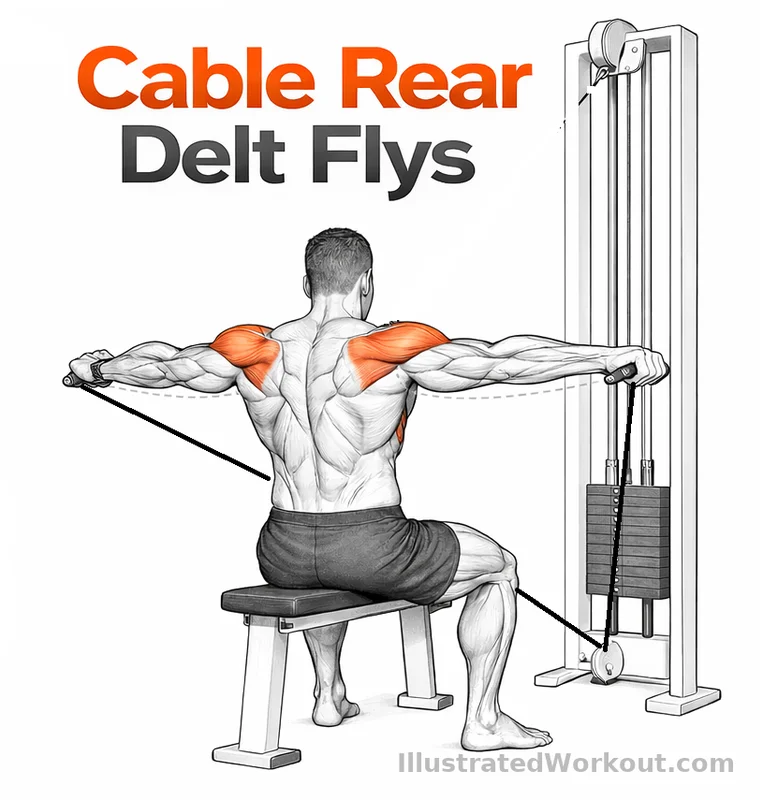
Cross-cable rear-delt fly with arms forming an X — direct posterior deltoid loading with constant tension and a clean line of pull.
Want a cable shoulder workout?
Our wizard builds one around your time, goal, and equipment in about two minutes. Free — no signup needed.
Make Me a Workout → Just did it? Track your setsCross-cable rear-delt fly with arms forming an X — direct posterior deltoid loading with constant tension and a clean line of pull.
Level: Beginner
Primary: Shoulders - Rear
Movement: Isolation
Tags: Pull
Type: Strength (Weight Lifting)
Equipment: Cable
Sports: Football Swimming
Target muscles
The posterior deltoids are the prime movers through horizontal shoulder abduction. The middle trapezius and rhomboids retract the scapulae. The infraspinatus and teres minor (rotator cuff) externally rotate the shoulders through the end range. The serratus anterior stabilizes the scapulae. The biceps grip the handles and assist at the elbow lightly. Most lifters' rear delts are dramatically underdeveloped relative to their anterior delts — pressing volume builds the front, but few movements specifically train the back. This is one of the few that does.
How to perform
Setup
Set two cables at shoulder height with D-handle attachments. Stand in the middle facing the cables. Reach across the body to grip each handle with the opposite hand — left hand on the right cable, right hand on the left cable. The arms form an X across the body. Step back to put tension on the cables. Slight knee bend, trunk braced, chest up.
Execution
With a slight bend in the elbows that stays consistent, pull the handles apart by driving the hands out to the sides and slightly back. The shoulder blades retract as the arms reach the end range. Squeeze the rear delts and the middle traps at the contracted position for a one-second peak hold. Return the handles slowly through the same arc to the start. The torso stays still throughout — no swaying, no twisting. The arms cycle, the body doesn't.
Common mistakes
- Going too heavy and using momentum. The rear delts are small; light strict reps are the right approach.
- Letting the elbows bend more during the rep. Maintain the consistent slight bend.
- Pulling with the lower traps instead of the rear delts. The shoulder blades retract slightly, but the work should feel in the back of the shoulder, not down the back.
- Body swaying to launch the handles. The body stays anchored.
- Stopping the reps short of the end-range squeeze. The peak contraction is most of the value.
Progressions and regressions
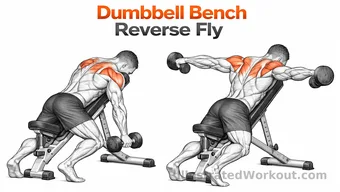
Regress to dumbbell rear-delt flyes (lying face-down on an incline bench) until the pattern is clean. The face pull is a related rear-delt-and-rotator-cuff exercise that uses a rope and a higher cable position. To progress, work pause flyes (3-second hold at peak), single-arm cable rear-delt flyes, or chain with face pulls in a superset.
Programming notes
Accessory work after the main back lifts. 3-4 sets of 12-15 reps, two or three times a week. The rear delts respond well to high frequency and high volume; cumulative weekly volume matters more than any single heavy session. Pair with face pulls and band pull-aparts in every upper-body training week to keep the shoulders balanced. Most lifters undertrain this region and the consequences (rounded shoulders, pressing injuries) show up over years.