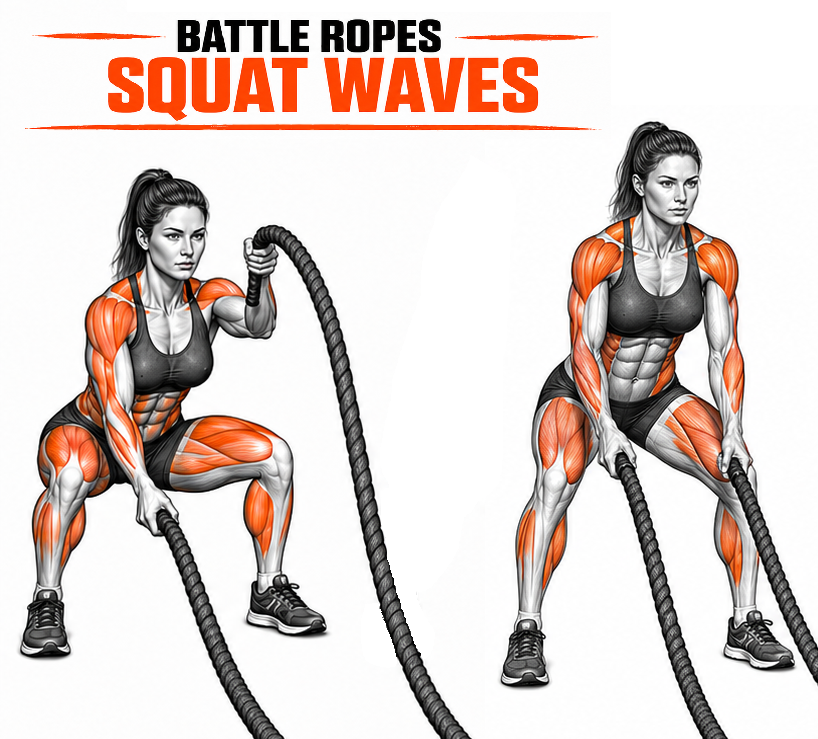
Battle Ropes Squat Waves
The shoulders keep the waves alive while you hold or pulse a squat, adding a steady quad and glute burn to the rope conditioning.
Level: Foundation
Primary: Shoulder
Secondary: Cardio Glutes Quads
Movement: Compound
Tags: Squat
Type: Aerobic (Cardio) Anaerobic Intervals (HIIT / Bootcamp / Circuit)
Equipment: Battle Ropes
Target muscles
The anterior and lateral deltoids drive the continuous waves while the forearms grip, the same upper-body work as a standing wave. Holding or pulsing a squat keeps the quads and glutes under load throughout, either isometrically in a held position or dynamically if you pulse up and down. The core braces to keep the torso tall over the working legs, and combining the squat with the constant arm work elevates the heart rate, making this a solid lower-body-and-shoulder conditioning drill.
How to perform
Setup
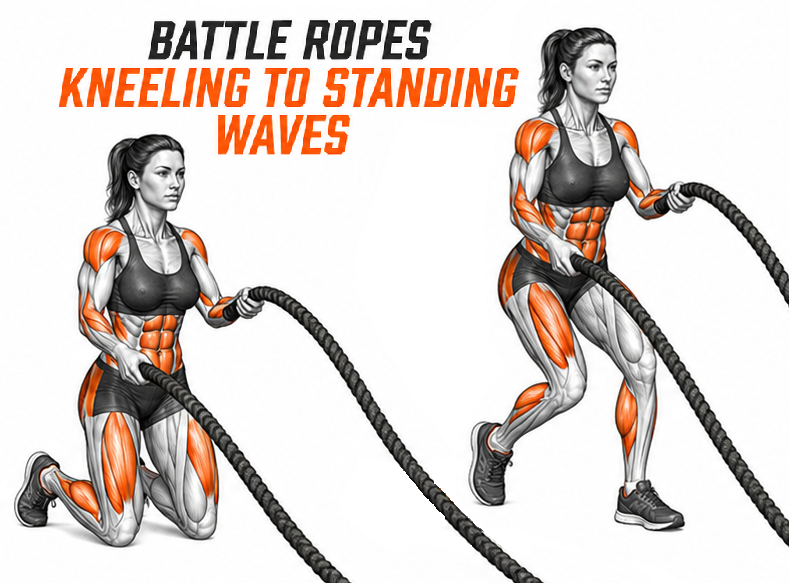
Hold a rope end in each hand facing the anchor with light tension on the line. Set the feet shoulder-width or slightly wider, sit the hips back and down into a squat to about parallel, and brace the trunk with the chest tall and the shoulders set down. Keep the knees tracking over the toes and your weight through the midfoot. Sink fully into the squat and feel the quads load before you start driving the waves so the legs stay involved.
Execution
Hold the squat — or pulse gently up and down a few inches — while driving fast alternating or double waves with the arms, keeping the amplitude tall and even. If pulsing, keep the range small and controlled so the squat depth stays honest. Keep the chest up, the knees tracking over the toes, and the weight through the midfoot. Maintain the waves to the anchor and resist standing fully upright, since staying in the squat is what loads the legs and separates this from a plain standing wave.
Common mistakes
- Standing up out of the squat as fatigue sets in, which removes the leg challenge.
- Letting the knees cave inward in the held or pulsing squat.
- Rounding the chest down toward the floor instead of staying tall over the hips.
- Letting the waves fade because the focus drifts entirely to the squat.
Progressions and regressions
Regress by squatting to a shallower depth, standing a little taller, or shortening the interval until the legs hold the position with good posture. Progress by squatting deeper, holding rather than pulsing for a tougher isometric, lengthening the work bout, or switching to double waves. Adding jump squats between waves turns it into a far more explosive movement, while a wider stance shifts more of the load onto the glutes and adductors.
Programming notes
Use it in 20-40 second intervals for 4-6 rounds with matched rest, as a conditioning station or a legs-and-shoulders finisher. The held squat makes it more demanding than a standing wave, so keep the depth honest and the waves full. It pairs well with upright wave and slam variations to vary how the lower body is loaded across a session.