Barbell T-Bar Row
Hinged row with one end of a barbell anchored — a brutal mid-back mass builder with a thick neutral-grip pull.
Level: Intermediate
Primary: Back - Upper
Secondary: Biceps
Movement: Compound
Tags: Pull
Type: Strength (Weight Lifting)
Equipment: Barbell
Sports: Football Rugby Swimming Wrestling
Target muscles
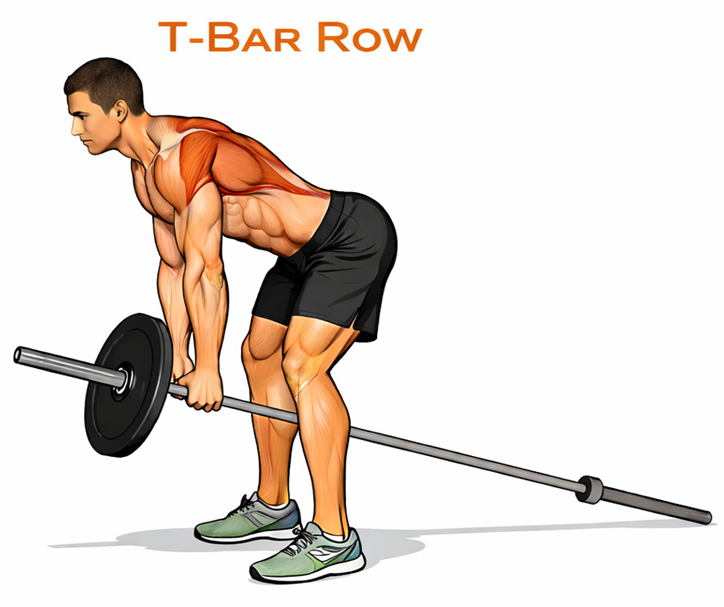
The latissimus dorsi drive the pull from the stretched position. The rhomboids and middle trapezius drive scapular retraction at the top. The rear deltoids contribute on the wide-elbow path. The biceps brachii, brachialis, and brachioradialis assist at the elbow — the neutral grip splits the difference between full supination and pronation, loading both biceps and brachioradialis well. The spinal erectors hold the hinge isometrically; the glutes and hamstrings work to maintain the hip position.
How to perform
Setup
Anchor one end of a barbell in a corner with a folded towel or in a landmine attachment. Straddle the bar facing the anchor. Hinge forward at the hips with a slight knee bend — back flat, shoulders just in front of the working end. Grip the bar with a neutral V-grip attachment, a thick-handle attachment, or just both hands around the bar end. Tighten the lats, pull the bar slightly off the floor, brace the trunk.
Execution
Row the bar toward your lower chest or upper abdomen by driving the elbows back. Squeeze the shoulder blades together at the top — a hard one-second contraction. Lower the bar under control to a fully stretched position; let the lats lengthen. Don't yank with the lower back to start the rep, and don't stand the torso up to use body english. The hinge stays locked through every rep. Exhale at the top of each row.
Common mistakes
- Standing the torso up to use the lower back as a lever. Pick a torso angle and stay there.
- Rowing to the upper chest instead of the lower chest or stomach. The path matters.
- Letting the lower back round at the bottom. Maintain the neutral arch; if you can't, lighten the load.
- Hands too close to the plates, which shortens the leverage. Grip at the very end of the bar for the longest lever.
- Bouncing reps off the floor. Set the lats and brace before each rep; touch and lift, don't drag and yank.
Progressions and regressions
Regress to chest-supported rows (T-bar with chest pad, seal row) if lower-back endurance limits the work. Single-arm dumbbell rows are useful unilateral stepping stones. To progress, work the supinated T-bar row (palms up grip, more biceps), the Meadows row (single-arm landmine row with a body pivot), or load up the bilateral version to heavy weight with straps once the back strength matches the grip.
Programming notes
Excellent primary row variation: 3-4 sets of 6-10 reps after a heavy bench day or as the main back lift on a pull day. Once or twice a week. Pair pressing volume with at least equal pulling volume to keep the shoulders healthy. The T-bar's neutral grip is friendlier to the elbows than a straight-bar bent row for most lifters who get joint cranky from heavy pulling.