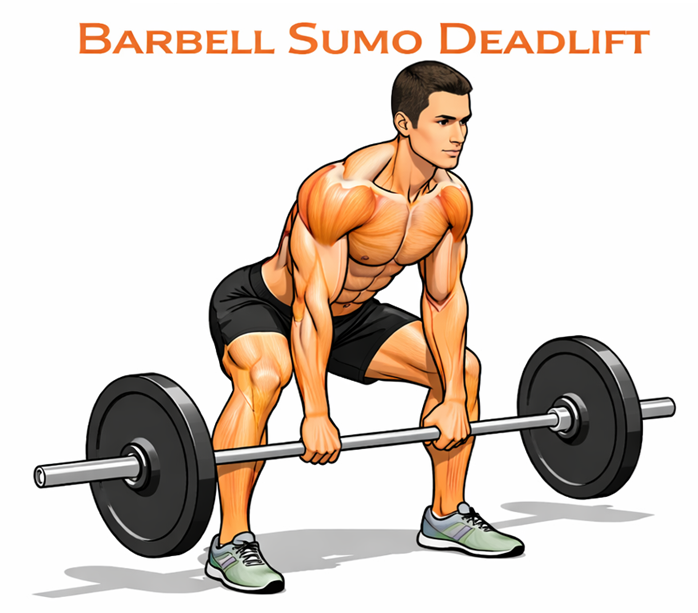
Barbell Sumo Deadlift
Wide-stance deadlift with the hands inside the legs — shorter pull, more quad and adductor involvement than conventional pulls.
Level: Intermediate
Primary: Back - Lower
Secondary: Glutes Hamstrings
Movement: Compound
Tags: Hinge Primary Lift
Type: Strength (Weight Lifting)
Equipment: Barbell
Sports: Football Rugby Track and Field Wrestling
Target muscles
The wide stance brings the adductor magnus and medius into the work as primary movers — they fire hard to keep the knees from collapsing in and to drive the hips through. The gluteus maximus drives hip extension. The quadriceps contribute more to the lift than in conventional deadlifts because the hip is in a more abducted, externally rotated position. The spinal erectors hold position against the bar load. Hamstrings co-contract for hip extension and knee stability. The traps, lats, and forearms all work to hold the bar tight to the body.
How to perform
Setup
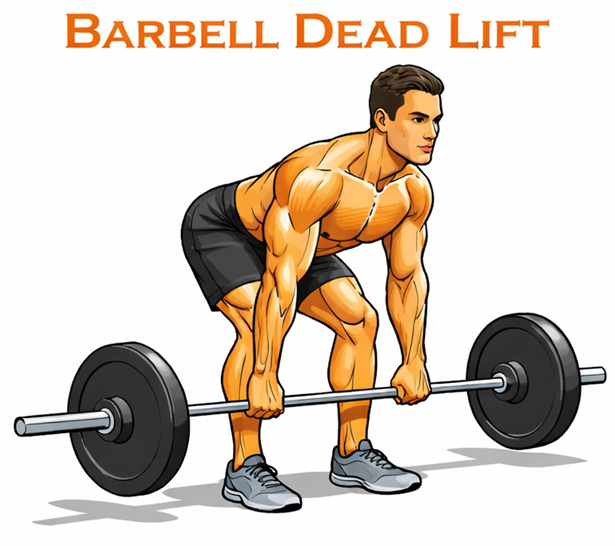
Stand with feet much wider than shoulder-width — for most lifters, just inside the smooth marking on the barbell. Toes turned out 30-45 degrees. Bar over mid-foot. Hinge straight down to grip the bar with hands shoulder-width apart, between the legs. Hook grip is preferred if you've trained it; mixed grip otherwise. Chest up, hips a little lower than in a conventional setup, shoulders just slightly in front of the bar. Pack the lats tight. Big breath, brace.
Execution
Push the floor away with the legs and pull the bar smoothly up — knees drive out over the toes throughout. The bar travels essentially straight up — sumo's bar path is shorter than conventional. As the bar passes the knees, the hips drive through forward to finish at lockout. Stand tall with shoulders over hips, glutes squeezed. Don't lean back. Lower the bar by reversing the motion — push the hips back first, then bend the knees once the bar passes them. Bar should track close to the legs the whole way.
Common mistakes
- Knees collapsing inward on the way up. Drive them out actively throughout the entire lift.
- Hips shooting up faster than the bar. Chest and hips rise together — if the hips lead, it's no longer a sumo deadlift.
- Bar drifting forward off the body. The lats pack the bar tight to the shins and thighs.
- Stance too narrow, which converts the lift into a partial conventional. Sumo stance is wide — the toes should approach the smooth markings on a standard barbell.
- Loading without first owning the position. Sumo demands hip mobility most lifters underdevelop; spend a few sessions in the bottom position with light weight before chasing PRs.
Progressions and regressions
Regress to a moderately wide-stance deadlift (semi-sumo) to teach the pattern with less mobility demand. Practice empty-bar sumo deadlifts to dial in foot position and stance. To progress, work deficit sumo deadlifts (standing on a 1-2 inch platform), block pulls from below the knees, and pause sumo deadlifts (1-second pause just below the knee). Sumo is a separate lift from conventional; both can be trained, but most lifters specialize.
Programming notes
Train heavy once a week if sumo is your primary deadlift. 3-5 sets of 1-5 reps for strength, 3-4 sets of 5-8 for hypertrophy. As a variation in a conventional-focused program, every other week at moderate loads (3-4 sets of 5 at 70-80%). The hip and adductor mobility demand is higher than conventional, so spend the first 4-6 weeks at moderate loads dialing in position before pushing intensity.