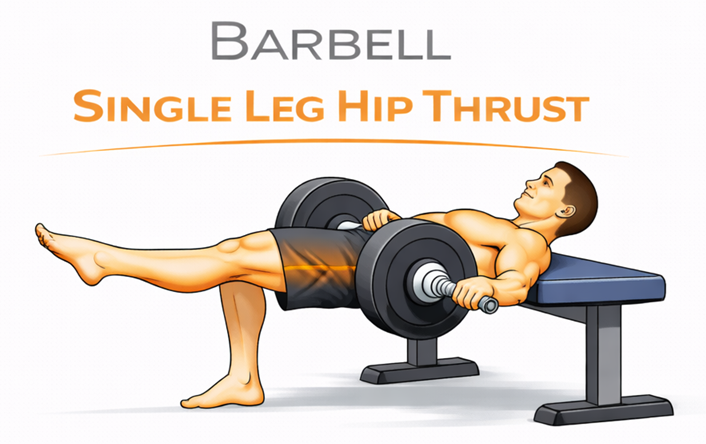
Barbell Single Leg Hip Thrust
Loaded single-leg hip thrust — exposes side-to-side glute strength differences and builds heavy hip extension per leg.
Level: Intermediate
Primary: Glutes
Secondary: Hamstrings
Movement: Compound
Tags: Balance / Stability Hinge Unilateral
Type: Strength (Weight Lifting)
Equipment: Barbell
Sports: Basketball Football Running Soccer Tennis Track and Field
Target muscles
The gluteus maximus of the working leg drives the entire concentric and eccentric — and the gluteus medius works continuously to keep the pelvis level. With one leg removed from the work, the demands per side roughly double compared to a bilateral hip thrust. The hamstrings of the working leg co-contract for knee stability. The trunk muscles brace asymmetrically — the side opposite the working leg loads more, similar to a single-arm carry. The hip flexors of the non-working leg work to hold the elevated position.
How to perform
Setup
Sit on the floor with the upper back against a flat bench (the edge hitting just below the shoulder blades). Roll a loaded barbell up to the hips with a barbell pad between bar and body. Plant one foot flat on the floor about shin-vertical-at-the-top distance from your hips. Extend the other leg out in front, held a few inches off the floor — knee straight, foot relaxed. Grip the bar lightly to stabilize.
Execution
Drive through the planted heel and the whole foot to extend the hips, lifting the bar and your hips until the body forms a straight line from shoulder to working knee. Squeeze the glute of the working leg hard at the top — a true squeeze, not a bounce. Keep the elevated leg level with the body at lockout; don't let it drop or rise. Lower the hips with control until the bar is just above the floor. Complete all reps on one side before switching.
Common mistakes
- Hyperextending the lower back at the top. Lockout is hip extension, not lumbar extension. Tuck the chin and squeeze the glute.
- Letting the non-working leg drift down or up during the rep. Hold it level — it's a stability requirement.
- Foot too far forward, turning the lift into a hamstring movement. The working shin should be vertical at lockout.
- Loading the same weight as a bilateral hip thrust. Single-leg loads typically run 40-60% of bilateral; ego-loading collapses the form.
- Letting the pelvis tilt toward the working side. The glute medius is supposed to fight that tilt — if you can't keep the hips level, drop the load.
Progressions and regressions
Regress to the single-leg glute bridge (no bench, no barbell) until you can produce a clean lockout with the elevated leg holding position. The B-stance hip thrust (rear foot lightly tapped, working leg taking 80% of the load) is a useful stepping stone with less stability demand. To progress, add pause reps at lockout (3-second hold), or deficit single-leg hip thrusts with the planted foot on a low platform for a deeper range.
Programming notes
Excellent for exposing and correcting glute imbalances. 3-4 sets of 6-10 reps per leg, two days a week. Run the working sets off the weaker side's numbers — don't push the strong side harder just because it can do more. The glutes recover well, but single-leg work compounds quickly; if you find the planted leg's quad doing more work than the glute, drop the load and re-cue. Pair with bilateral hip thrusts for a full glute program.