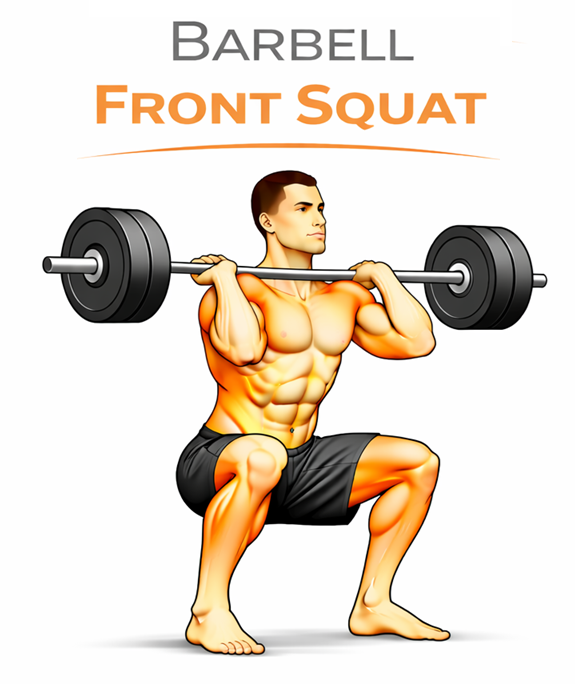
Barbell Front Squat
Front-rack barbell squat with the bar across the shoulders — demands an upright torso, brutal for the quads and trunk strength.
Level: Intermediate
Primary: Quads
Secondary: Glutes Hamstrings
Movement: Compound
Tags: Primary Lift Squat
Type: Strength (Weight Lifting)
Equipment: Barbell
Sports: Basketball Football Rugby Track and Field Volleyball
Target muscles
The quadriceps take a larger share of the work than in a back squat because the front-rack bar position forces a more upright torso, which puts the knees deeper into flexion at depth. The gluteus maximus drives hip extension out of the hole. The trunk — rectus abdominis, obliques, spinal erectors — works far harder than in a back squat to fight the forward-pulling lever of the bar. The upper back, lats, and even the wrists contribute to holding the rack position. A strong front squat tells you a lot about a lifter's trunk and posture.
How to perform
Setup
Set the bar at upper-chest height in the rack. Step in close, get the bar resting across the front delts and the throat (yes, the throat — it should sit there comfortably with a clean grip), and rotate the elbows up and forward so they're parallel with the floor or higher. Use a clean grip (fingertips on the bar, palms up) if you have the wrist mobility; otherwise use a cross-arm grip with the arms folded over each other on the bar. Feet shoulder-width, toes slightly out. Big breath, brace, unrack.
Execution
Sit straight down with the torso staying as upright as possible — knees and hips break together. Drive the knees out over the toes through the descent. Hit depth (hip crease below the top of the knee). Stand by driving the elbows up — if the elbows drop on the way out of the hole, the bar rolls forward and the rep is lost. Don't pause at the top unless you need to; reset the brace and go again. The breathing pattern matters: inhale at the top, brace, descend, drive, exhale at the top of the rep before re-bracing.
Common mistakes
- Letting the elbows drop on the ascent. Cue "elbows up" through every rep — when they drop, the bar dumps.
- Trying to use the same load as your back squat. Most lifters front-squat 80-85% of their back squat. Build it as a separate number.
- Cutting depth because the load got heavy. Front squats expose anything less than full depth more obviously than back squats.
- Wrists pinned in extreme extension because the rack is sloppy. Spend time on wrist and lat mobility, or use the cross-arm grip until you can sit in a clean rack.
- Holding the breath through every rep on long sets. Inhale and brace, descend, drive, exhale at the top — repeat.
Progressions and regressions
Regress with goblet squats to groove the upright torso and bottom position. Then move to dumbbells held in front-rack position (this also exposes any wrist issues without barbell load on them). Build the bar-front-rack position with empty bar work for several sessions before going heavy. To progress, cycle in pause front squats (3-second pause at depth), tempo front squats, and Zercher squats (bar held in the elbow crease) for an even more upright variant. The clean from a hang ties cleanly into front-squat strength when both lifts are programmed together.
Programming notes
Excellent as the primary squat on a non-back-squat day, or as the second squat exercise after back squats. 3-5 sets of 3-6 reps for strength, 3-4 sets of 6-10 for hypertrophy. Once or twice a week. Pair with deadlift variations on the same program but on different days. The front squat carries less spinal compression than a back squat at equivalent intensities and is often a useful tool for athletes managing lower-back stress while still loading the legs hard.