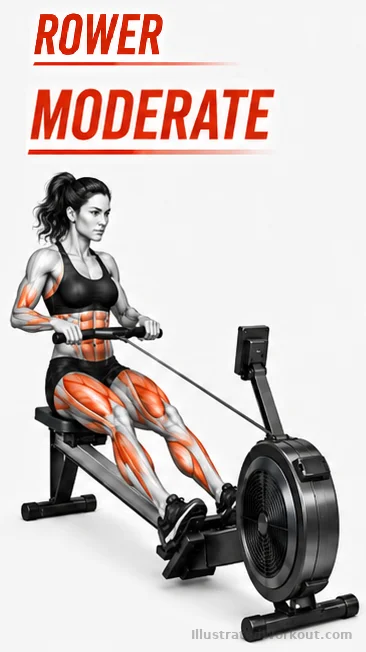
Rower Moderate
Continuous rowing at a working pace that links legs, back and arms into a powerful, sustained full-body aerobic effort.
Want a rower conditioning workout?
Our wizard builds one around your time, goal, and equipment in about two minutes. Free — no signup needed.
Make Me a Workout → Just did it? Track your setsContinuous rowing at a working pace that links legs, back and arms into a powerful, sustained full-body aerobic effort.
Level: Foundation
Primary: Cardio
Secondary: Back - Upper Hamstrings Quads
Movement: Compound
Type: Aerobic (Cardio)
Equipment: Rower
Target muscles
Rowing under real effort loads the entire posterior chain in sequence: the quadriceps and glutes fire hard to press the legs down at the catch, the hamstrings and lower back extend the hips as the torso swings open, and the upper back, rhombids, lats and biceps finish the drive by pulling the handle to the ribs. The core stays braced throughout to transmit force from legs to arms. Held continuously, this heavy muscular involvement drives a strong cardiovascular demand.
How to perform
Setup
Secure the feet, take a firm overhand grip, and sit tall at the catch with vertical shins, straight arms and the shoulders reaching past the hips. Brace the trunk so the spine stays long rather than rounding. Set a moderate damper, commonly around a middle setting, and aim for a steady working stroke rate you can sustain.
Execution
Drive powerfully in order, legs then hips then arms, so each stroke has a crisp, connected push rather than a soft heave. Control the recovery in reverse, arms away, hinge forward, then slide up on bent knees, keeping the recovery slower than the drive to set a sustainable ratio. Work at a five or six out of ten, an effort where breathing is deep and you can speak only in short bursts. Match the breath to the stroke, exhaling on the drive, and hold consistent stroke length and power for the full piece rather than surging and fading.
Common mistakes
- Opening the back too early so the hips shoot back before the legs finish, robbing the drive of power.
- Bending the arms at the start of the stroke instead of keeping them straight until the legs are down.
- Collapsing the posture at the finish by leaning too far back and rounding over the handle.
- Rushing up the slide on the recovery, which raises the effort and burns you out before the piece ends.
Progressions and regressions
Regress by dropping the stroke rate and effort toward a Rower Light pace or shortening the duration. Progress by extending the piece, raising the stroke rate, lifting the damper for more resistance per stroke, or targeting a steady pace goal such as a set split per five hundred metres. Interval surges move it toward Rower Sprint conditioning.
Programming notes
Use it as a full-body aerobic session for fifteen to forty minutes, two or three times a week, either as steady cardio or as the engine work inside a conditioning plan. Because it trains legs, back and arms together with no impact, it is efficient cross-training alongside lifting and easy on the joints. Hold the pace in the moderate band; let it drift too easy and the stimulus fades, push it too hard and it becomes a sprint session that needs its own recovery.