Jump Rope
A classic two-foot rope-skipping drill that drives the cardiovascular system while building calf endurance, rhythm and foot speed.
Level: Beginner
Primary: Cardio
Secondary: Calves
Movement: Isolation
Type: Aerobic (Cardio) Anaerobic Intervals (HIIT / Bootcamp / Circuit) Plyometric
Equipment: Jump Rope
Target muscles
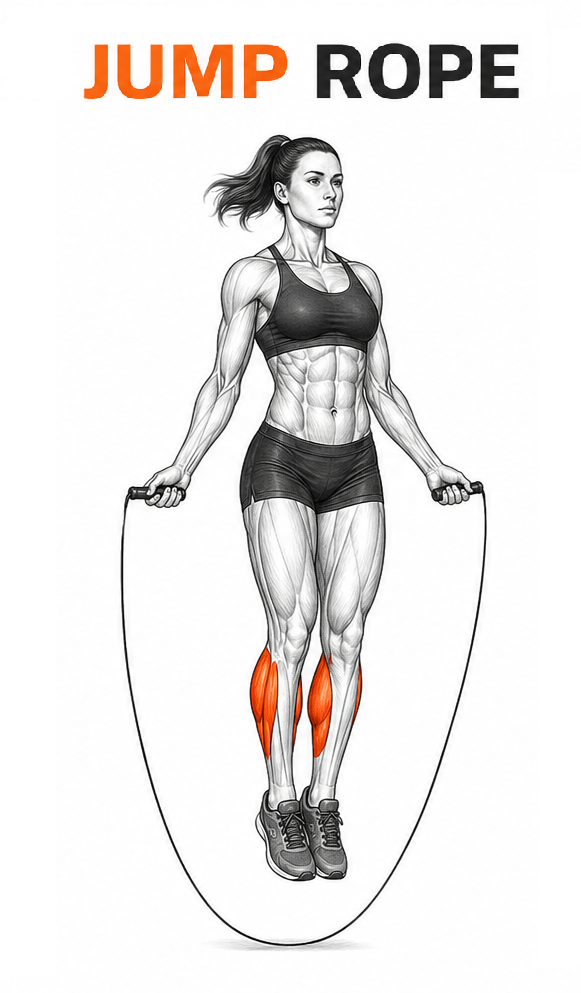
The calves — gastrocnemius and soleus — carry the load, springing off the floor and absorbing each landing hundreds of times per minute. The quads and glutes contribute small bounces, the forearms and shoulders turn the rope, and the core holds an upright posture. Above all it taxes the heart and lungs, making it one of the most efficient conditioning tools for the space it takes.
How to perform
Setup
Size the rope so the handles reach roughly to your armpits when you stand on the middle. Hold the handles at hip height, elbows tucked close to the ribs. Stand tall with feet together and weight on the balls of the feet.
Execution
Turn the rope with the wrists, not the whole arm, and hop just high enough to clear it — an inch or two off the floor. Land softly on the balls of the feet with the knees slightly bent to absorb each contact. Keep the jumps small, quick and rhythmic, and let the wrists do the spinning so the shoulders stay relaxed. Look forward rather than down at your feet. Find a steady cadence and breathe in time with the rhythm. Once basic bouncing is smooth, the same setup carries over to faster and more varied footwork.
Common mistakes
- Jumping far too high, which wastes energy and pounds the joints on landing.
- Spinning the rope with the whole arm instead of flicking it with the wrists.
- Landing flat-footed and heavy rather than springing softly off the balls of the feet.
- Looking down at the feet, which rounds the back and throws off the rhythm.
Progressions and regressions
Regress by practising the rope turn and the bounce separately, or by doing low pogo hops without the rope until the timing clicks. Progress to single-leg skips, high-knee skips, double-unders where the rope passes twice per jump, or criss-cross patterns. A weighted rope adds upper-body demand once the rhythm is reliable.
Programming notes
Use it as a warm-up to spike the heart rate, or as interval conditioning — thirty seconds on, thirty off, for ten to twenty rounds. It also works as active recovery between strength sets. Because it is repetitive impact on the calves and Achilles, build volume gradually and avoid loading it heavily the day before hard sprint or jump work.