Dumbbell Renegade Rows
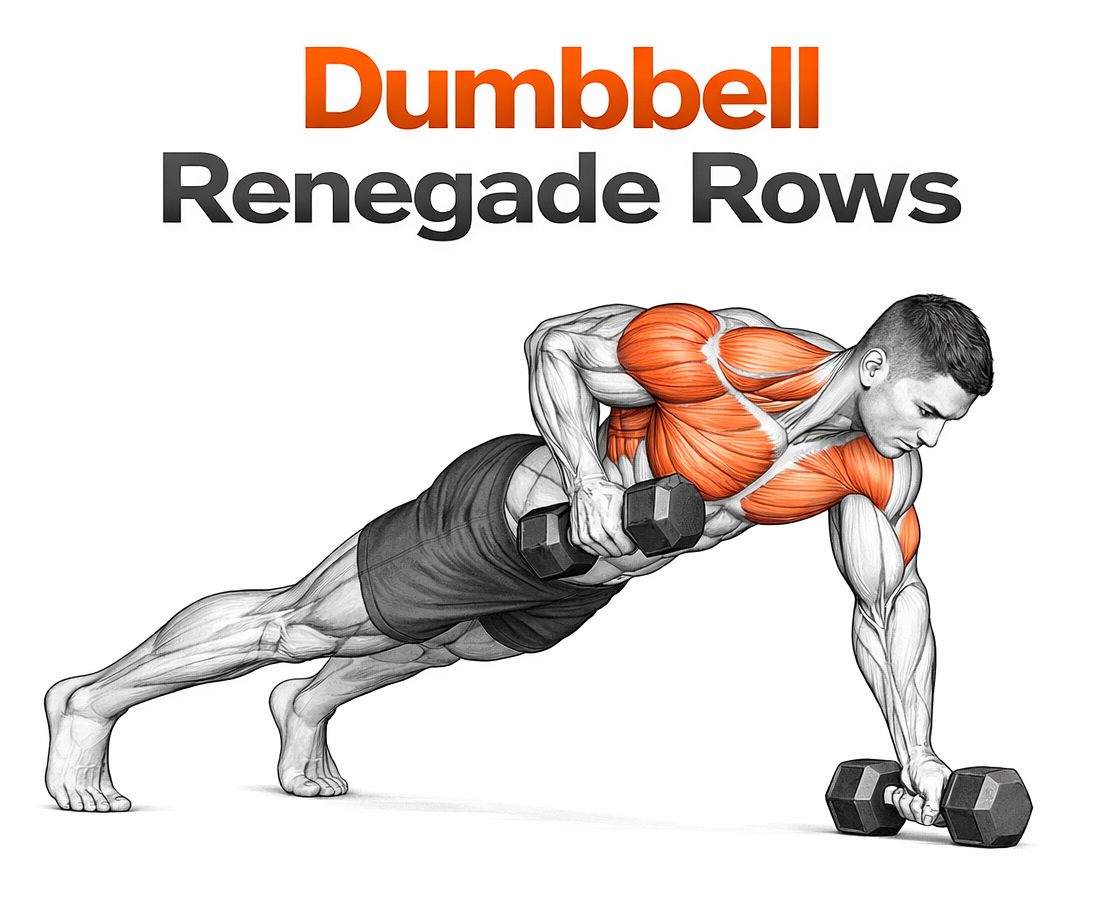
Push-up plank with alternating one-arm dumbbell rows — extreme anti-rotation work disguised as a back exercise.
Level: Intermediate
Primary: Full Body
Movement: Compound
Tags: Anti-Rotation Pull
Type: Strength (Weight Lifting)
Equipment: Dumbbell
Sports: Football Rugby Swimming Wrestling
Target muscles
The latissimus dorsi and rhomboids of the working side drive the row. The obliques and deep core fire continuously to resist trunk rotation — every row tries to twist you. The lats of the supporting side hold the plank position. The triceps and serratus anterior of both sides hold the body up. The glute medius of the planted-foot side keeps the hips level. Done well, the renegade row is more a trunk exercise than a row — most lifters' rows look fine and their planks fall apart.
How to perform
Setup
Set up in a high plank position with each hand gripping a dumbbell on the floor (hexagonal or flat-edged dumbbells for stability). Feet wider than hip-width for a stable base. Body in a straight line from head to heels. Trunk braced hard.
Execution
Row one dumbbell up to the hip by driving the elbow back and up. The hips stay absolutely level throughout — they should not rotate toward the working side. Pause briefly at peak contraction. Lower the dumbbell back to the floor under control. Switch and row the other side. Alternate continuously, or complete reps on one side at a time.
Common mistakes
- Hips rotating toward the rowing side. The hips stay square — this is the entire point.
- Going too heavy. The trunk demand caps the working weight; pick a load that lets you hold a clean plank throughout.
- Sagging hips during the row. The body line stays straight.
- Round dumbbells that wobble on the floor. Use hex-shaped or flat-edged dumbbells.
- Feet too close together. Widening the feet stabilizes the plank.
Progressions and regressions
Regress to push-up plank holds with no rows until the position is solid. Then to renegade rows with a wider foot stance for more stability. To progress, narrow the feet for greater anti-rotation demand, use heavier dumbbells, or add a push-up between rows for a combined exercise.
Programming notes
Excellent trunk-and-back combination work. 3-4 sets of 6-10 reps per side. Two times a week. The trunk demand makes this a complete posterior chain stimulus without much lower-back stress. Pair with hip thrusts and pull-ups for a complete back and glute program.