Dumbbell Goblet Squat
Single-dumbbell squat with the weight held vertically at the chest — the most accessible loaded squat, ideal for learning and maintaining form.
Level: Foundation
Primary: Quads
Secondary: Glutes Hamstrings
Movement: Compound
Tags: Squat
Type: Strength (Weight Lifting)
Equipment: Dumbbell
Sports: Basketball Football Rugby Track and Field Volleyball
Target muscles
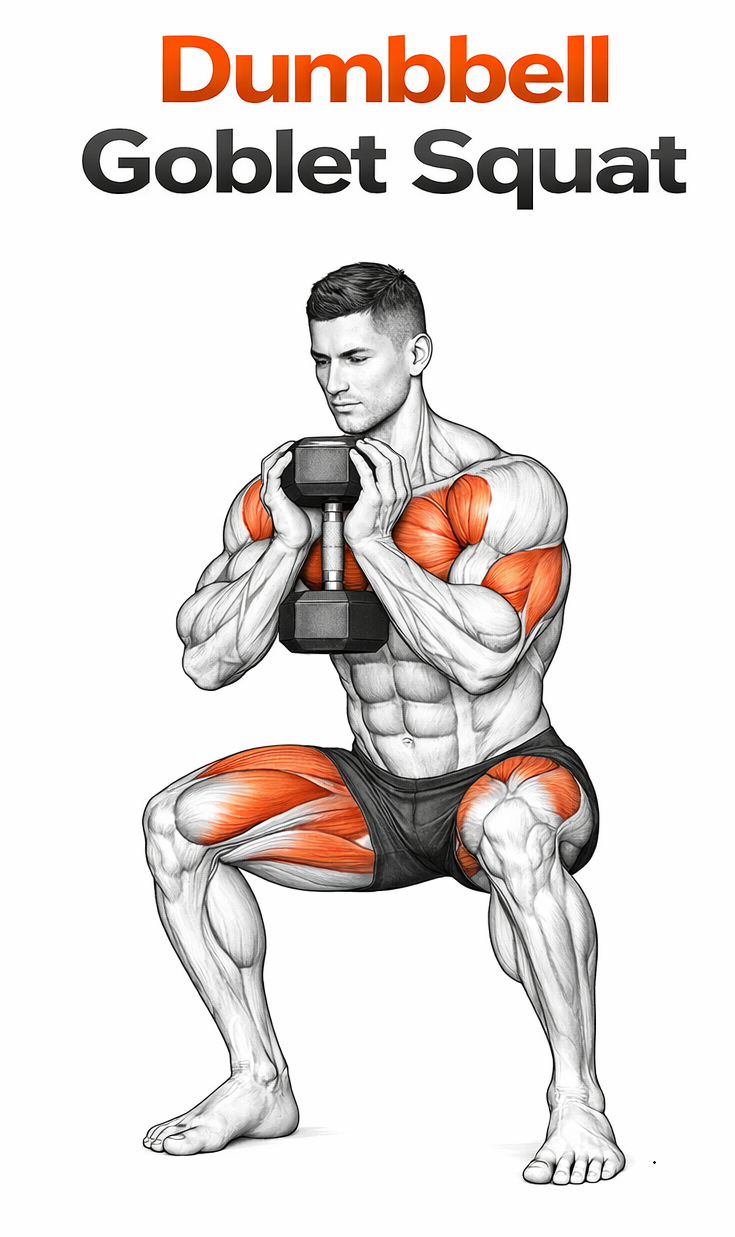
The quadriceps drive knee extension. The gluteus maximus drives hip extension. The hamstrings co-contract. The trunk works hard isometrically against the front-loaded weight at the chest — the abs and erectors keep the torso upright. The upper back stabilizes the dumbbell at the chest. The biceps and forearms grip the dumbbell. The front-rack-style loading naturally produces a more upright squat than a back squat, which is often friendlier to the lower back.
How to perform
Setup
Hold a dumbbell vertically at the chest, cupping the top end with both hands like a goblet. Elbows tucked tight to the body. Feet shoulder-width apart, toes slightly turned out (15-30 degrees). Trunk braced, chest up.
Execution
Sit straight down — knees and hips break together. Keep the torso vertical and the elbows tucked. Drive the knees out over the second toes through the descent. Continue to depth (hip crease below the top of the knee), with the elbows brushing the inside of the knees at the bottom for many lifters. Drive through the full foot to stand, finishing with the hips extended. The dumbbell stays at the chest through the entire rep; if it drops, the load is too heavy or the elbows have drifted out.
Common mistakes
- Letting the elbows drift forward and up during the descent. The dumbbell stays close to the body, elbows tucked.
- Knees collapsing inward at the bottom. Drive them out actively.
- Torso pitching forward. Stay tall; the goblet position naturally encourages an upright torso.
- Cutting depth as the load gets heavy. The goblet squat scales the load by holding the dumbbell, but the depth shouldn't change.
- Heel lifting. If you can't keep the heels down at depth, work ankle mobility before chasing depth or load.
Progressions and regressions
Regress to bodyweight squats until the pattern is solid. To progress, work pause goblet squats (3-second pause at depth), heavier dumbbells (40-80 pounds), or move to front squats with a barbell once the dumbbell becomes the limiting factor.
Programming notes
Excellent primary squat for beginners and intermediates, or as accessory work after barbell squats. 3-4 sets of 8-12 reps. Two or three times a week. The goblet squat tolerates higher frequency than barbell squats because the loading is lower and the spinal compression is minimal. Pair with deadlift variations for a complete lower-body program.