Dumbbell Floor T-Raises
Prone T-raise on the floor with dumbbells — direct rear-delt and middle-trapezius work with no trunk demand to interfere.
Want a dumbbell shoulder workout?
Our wizard builds one around your time, goal, and equipment in about two minutes. Free — no signup needed.
Make Me a Workout → Just did it? Track your setsProne T-raise on the floor with dumbbells — direct rear-delt and middle-trapezius work with no trunk demand to interfere.
Level: Beginner
Primary: Shoulders - Rear
Movement: Isolation
Type: Strength (Weight Lifting)
Equipment: Dumbbell
Sports: Swimming Volleyball
Target muscles
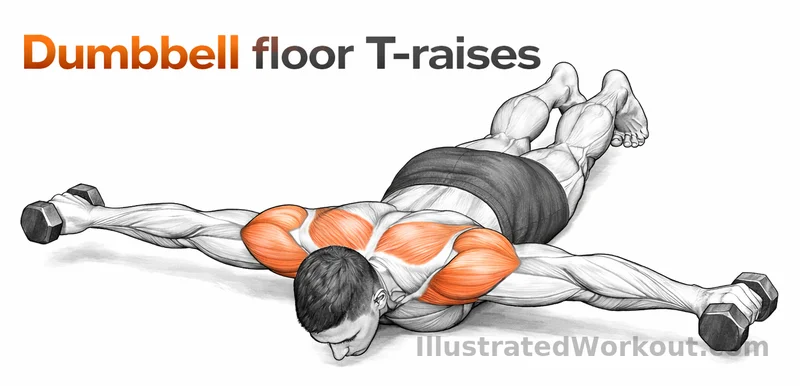
The posterior deltoids drive shoulder horizontal abduction. The middle trapezius and rhomboids retract the scapulae through the lift. The rear-shoulder rotator-cuff muscles assist. The lower trapezius depresses the scapulae. With the chest pressed to the floor, the lower back and trunk are completely removed from the work — the load concentrates entirely on the upper-back and rear-shoulder muscles. As clean rear-delt isolation goes, the floor T-raise is hard to beat.
How to perform
Setup
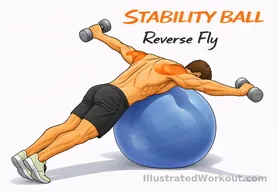
Lie face-down on the floor holding a dumbbell in each hand. Extend the arms out to the sides at shoulder height to form a T shape. Palms can face up or be in a neutral position with thumbs pointing forward — both work; pick what's comfortable. Forehead rests gently on the floor or just hovers above it. Take a breath.
Execution
Lift both dumbbells off the floor by retracting the shoulder blades and engaging the rear delts. The arms stay straight throughout — slight elbow bend is fine, but no bending during the lift. Squeeze the rear delts and middle traps at the top for a one-second hold. Lower the dumbbells back to the floor with control. Don't rest the weight fully; just touch and lift again. The chest stays on the floor throughout; if it lifts, the trunk is doing work that should belong to the back.
Common mistakes
- Lifting the chest off the floor to use leverage. The chest stays down.
- Bending the elbows to make the lift easier. Keep the arms straight.
- Loading too heavy. Light dumbbells (5-10 pounds) are appropriate; the rear delts are small.
- Rushing the reps. Slow controlled — two seconds up, one-second hold, two seconds down.
- Not pausing at the top. The peak contraction is most of the value.
Progressions and regressions
Regress to bodyweight T-raises (no dumbbells) until the back muscles fire cleanly. To progress, work pause T-raises (3-second hold at peak), or alternate T, Y, and W positions in the same set (vary the arm angle for different fiber recruitment).
Programming notes
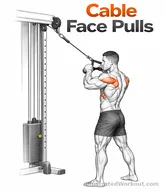
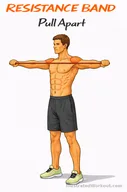
Excellent rear-delt accessory work, especially during pressing-heavy training blocks. 3 sets of 12-15 reps, two or three times a week. The floor position makes it accessible without a bench, which is useful in home gyms. Pair with face pulls and band pull-aparts for a complete rear-delt program.