Dumbbell Bench Press
Flat dumbbell bench press — chest pressing with independent dumbbells, deeper range than a barbell and easier on the shoulders.
Level: Foundation
Primary: Chest
Secondary: Shoulder Triceps
Movement: Compound
Tags: Push
Type: Strength (Weight Lifting)
Equipment: Dumbbell
Sports: Football Rugby
Target muscles
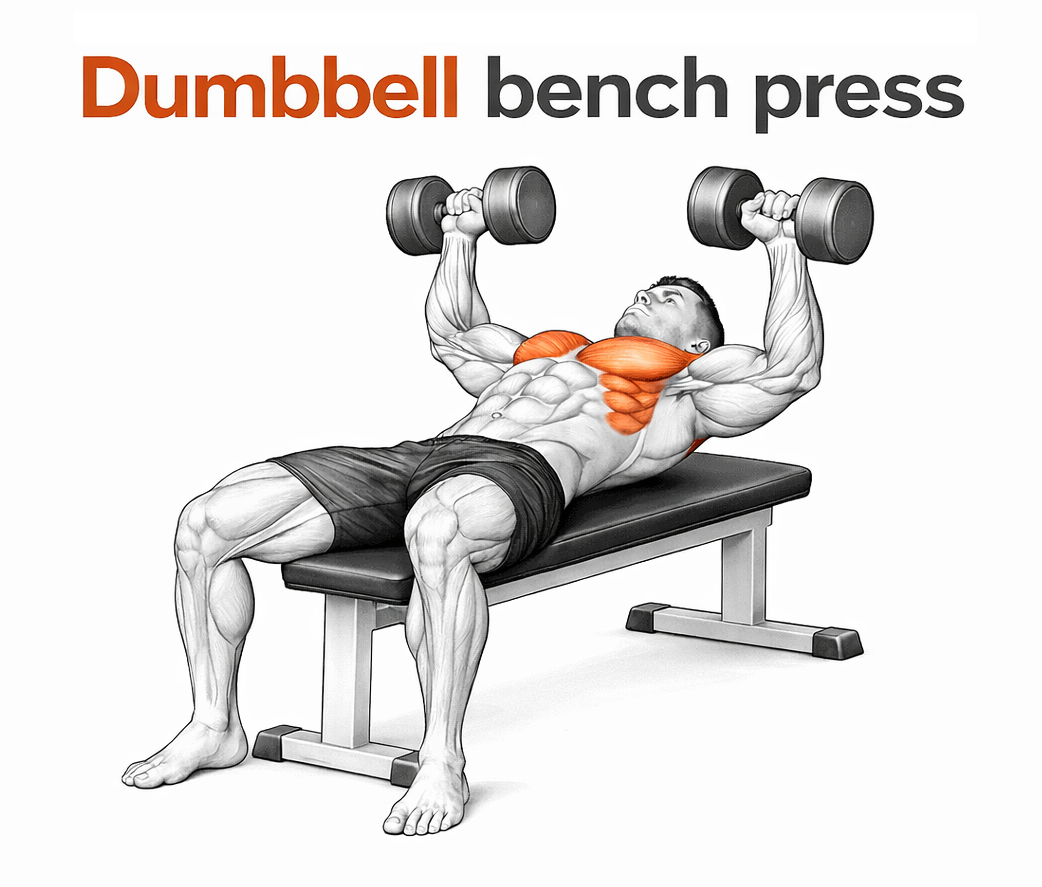
The pectoralis major drives horizontal adduction. The anterior deltoid contributes to shoulder flexion. The triceps brachii lock out the elbows. The serratus anterior holds the scapulae stable. The dumbbells' independent path lets each side work through its natural range — and lets the dumbbells travel deeper at the bottom than a barbell does, which loads the chest through more range. The cost is reduced loadability — most lifters dumbbell-press 70-85% of their barbell bench at equivalent strength.
How to perform
Setup
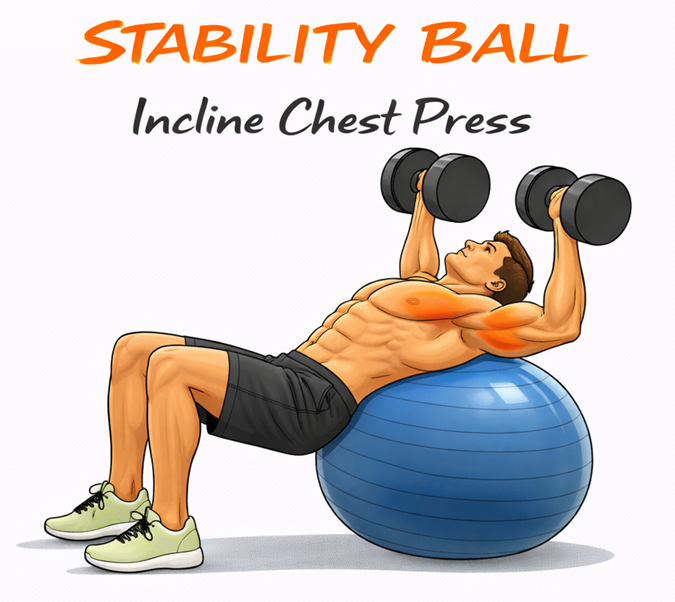
Sit on a flat bench with a dumbbell on each thigh. Lie back, using the legs to help bring the dumbbells up to chest level — the kick-up technique. Plant the feet flat on the floor. Pull the shoulder blades back and down, slight arch through the upper back. Dumbbells at chest level, palms facing forward, elbows tucked at about 45 degrees from the torso.
Execution
Press the dumbbells up by extending the elbows. At the top, the dumbbells should come close together (or touch lightly) directly over the chest. Squeeze the chest at the lockout. Lower the dumbbells under control back to the chest — for most lifters, this means the dumbbells travel slightly lower than a barbell would, with the elbows dropping just below the bench line. Pause briefly at the bottom. Press again. The dumbbells should travel in slight arcs that meet at the top and separate at the bottom.
Common mistakes
- Flaring the elbows out to 90 degrees. Tuck them at about 45 degrees from the torso, same as a barbell bench.
- Not bringing the dumbbells together at the top. The convergence is one advantage over a barbell; let the hands meet.
- Hips coming off the bench on heavy sets. Stay pressed down.
- Skipping the kick-up to get the dumbbells into starting position. Heavy dumbbell bench requires the kick-up — it's a real skill that saves shoulders.
- Losing control of one dumbbell on heavy sets. If you can't hold both safely, drop the load.
Progressions and regressions
Regress to a Smith machine or fixed-bar bench until comfortable with overhead loading. Floor presses with dumbbells limit the range and protect the shoulders during early training. To progress, work pause dumbbell bench (2-second pause at the chest), single-arm dumbbell bench (anti-rotation demand), or alternating dumbbell bench (one arm presses while the other holds at the top).
Programming notes
Excellent primary or secondary chest press. 3-4 sets of 6-12 reps. Two times a week. The deeper range loads the chest through more length than a barbell — particularly valuable for lifters whose chest development is lagging. Many lifters benefit from rotating barbell and dumbbell bench every few weeks for the variety in loading. Pair with rowing volume to keep shoulders balanced.