Dips
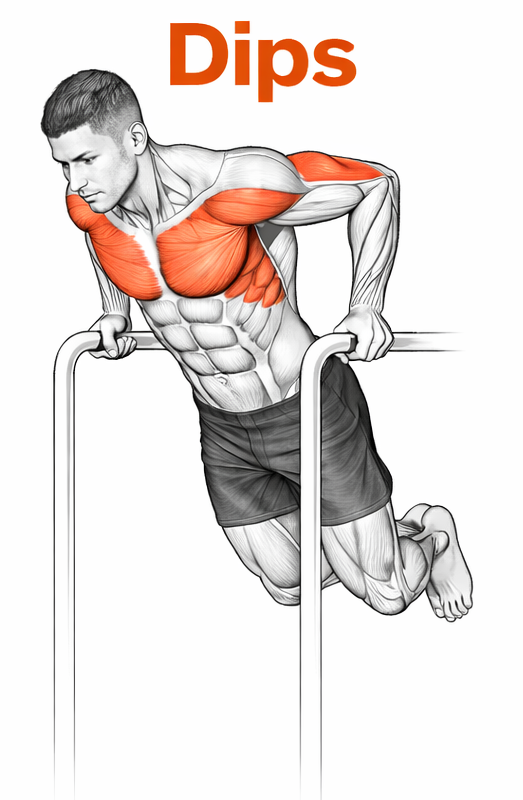
Bodyweight dip on parallel bars — pushes the chest and triceps through a press from a hanging position, the foundation of upper-body bodyweight strength.
Level: Beginner
Primary: Chest Triceps
Movement: Compound
Tags: Push
Type: Functional Fitness (Obstacle & Hybrid) Strength (Weight Lifting)
Equipment: Body Weight
Sports: Gymnastics MMA Wrestling
Target muscles
The pectoralis major (lower sternal fibers especially) and triceps brachii share the bulk of the work. The anterior deltoid contributes. With a forward torso lean, the chest takes more; with a vertical torso, the triceps take more — both styles are legitimate and useful. The serratus anterior holds the scapulae stable through the descent. The forearms grip the bars; the trunk braces continuously to keep the body from swinging. Dips are one of the few upper-body movements that load both the chest and triceps simultaneously through a long range.
How to perform
Setup
Mount a pair of parallel bars by jumping up to a starting support position — arms locked, body hanging between the bars, shoulders packed (down and away from the ears), slight forward torso lean if you want more chest, vertical torso if you want more triceps. Cross the ankles for trunk stability. Brace the trunk; squeeze the glutes lightly.
Execution
Lower the body by bending the elbows. The descent continues until the upper arms are roughly parallel to the floor — for chest-dip variants, the shoulder will go slightly below the elbow level. The elbows track in line with the wrists, neither flaring wide nor pinning so close that the joints feel pinched. Pause briefly at the bottom. Press back up to full elbow lockout, finishing with the shoulders packed and the trunk braced. Don't kip or swing for momentum.
Common mistakes
- Cutting the range — going only halfway down. The bottom of the dip is where the chest builds; touch full depth or count the rep as a fail.
- Shoulders shrugging up to the ears. Pack them down; the rotator cuff handles the load better with the shoulders set.
- Going below depth where the shoulders feel pinched. The "right" depth varies by lifter — some can go very deep, some shouldn't.
- Swinging the legs for momentum. Stay still; the chest and triceps do the work.
- Skipping the lockout at the top. Fully extend the arms; the lockout is where the triceps complete their work.
Progressions and regressions
Regress to bench dips (hands on a bench behind you, feet on the floor — much less load) until you can do at least three clean reps on parallel bars. Use a band looped around the bars and under one knee for assisted dips. To progress, add weight with a dip belt or weighted vest, work pause dips (3-second pause at the bottom), or move to ring dips for greater stability demand.
Programming notes
Primary or secondary pressing movement. 3-5 sets of 5-10 reps for strength, 3-4 sets of 8-12 for hypertrophy. Two times a week. Once you can do 10 clean unassisted reps, add weight — dips tolerate loading well. Pair with rowing volume to keep the shoulders balanced. Sometimes called the "upper-body squat" because of how much musculature they recruit; deserving of that nickname when programmed seriously.