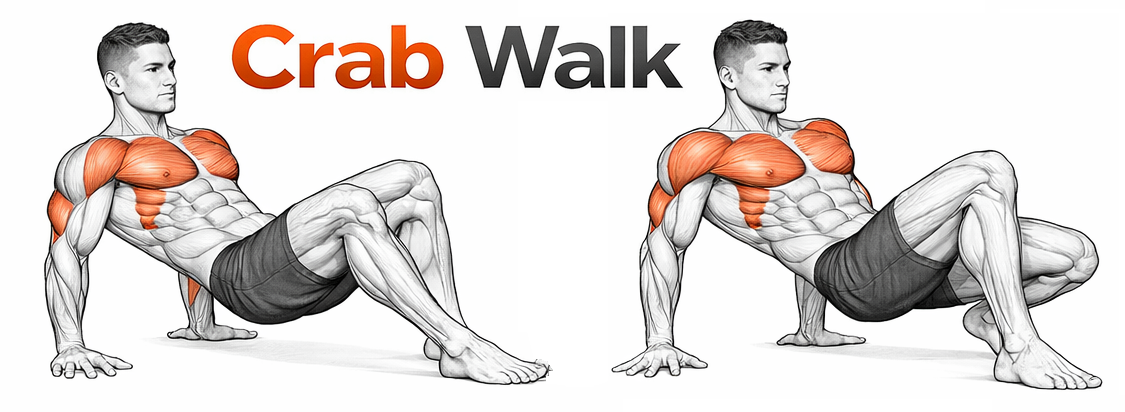
Crab Walk
Inverted floor crawl with hips lifted and chest open — flips the normal crawl orientation belly-up for unique shoulder and trunk work.
Level: Beginner
Primary: Cardio Full Body
Movement: Compound
Tags: Animal Movement
Type: Functional Fitness (Obstacle & Hybrid) Primal Movments (Animal Flow-QMT Specifics)
Equipment: Body Weight
Sports: Boxing MMA
Target muscles
The triceps brachii and posterior deltoids hold the body weight off the floor — the shoulders work in deep extension. The gluteus maximus and hamstrings hold hip extension to keep the hips elevated. The trunk muscles brace continuously against gravity. The wrists flex against the body's load — strong wrist mobility is a prerequisite or the position itself becomes the limiting factor. The cardiovascular cost climbs once the set passes a minute because the position is genuinely whole-body work.
How to perform
Setup
Sit on the floor with the legs bent and feet flat. Place the hands behind you with fingers pointing forward (toward your feet) — or, if your wrists prefer, fingers pointing back away from your body. Lift the hips off the floor so the body forms a flat tabletop — shoulders, hips, and knees roughly in a line. Take a breath, brace.
Execution
Walk forward, backward, or sideways using your hands and feet. The hips stay elevated throughout — if they drop, the working set is over. Move with a moderate pace; the hand and foot on opposite sides typically move together, mirror-imaging a standard crawl. Continue for the prescribed distance or time. The chest stays open through the entire walk; collapsing into a hunched position reduces the shoulder demand.
Common mistakes
- Hips dropping to the floor. The crab walk is a tabletop hold in motion — if the hips touch down, the working set is over.
- Wrists pointing the wrong way for your anatomy. Pick the direction that's comfortable (most lifters: fingers pointing toward the feet); don't fight the wrists.
- Hunched shoulders during the walk. Keep the chest open and the shoulders packed.
- Going too fast. Speed loses the trunk-control demand.
- Doing it daily with already-tight wrists or shoulders. The wrist load accumulates fast; rotate with other locomotor patterns.
Progressions and regressions
Regress to the static crab walk position (no movement — just holding the tabletop) for 20-30 seconds until the hips can stay elevated comfortably. To progress, work the crab walk for longer distances, add a kick-through (one leg sweeps through the body during the walk), or chain with bear-to-crab transitions for animal-flow sequences.
Programming notes
Excellent warm-up movement (one pass across the gym) or conditioning piece (30-60 seconds per round, 3-5 rounds). Two or three times a week. The wrist load is non-trivial; if wrists are cranky, use crab walk with fists or on knuckles instead of flat palms, or sub in another primal movement. Pair with bear crawls for both anterior and posterior loading patterns.