Cable Front Raises
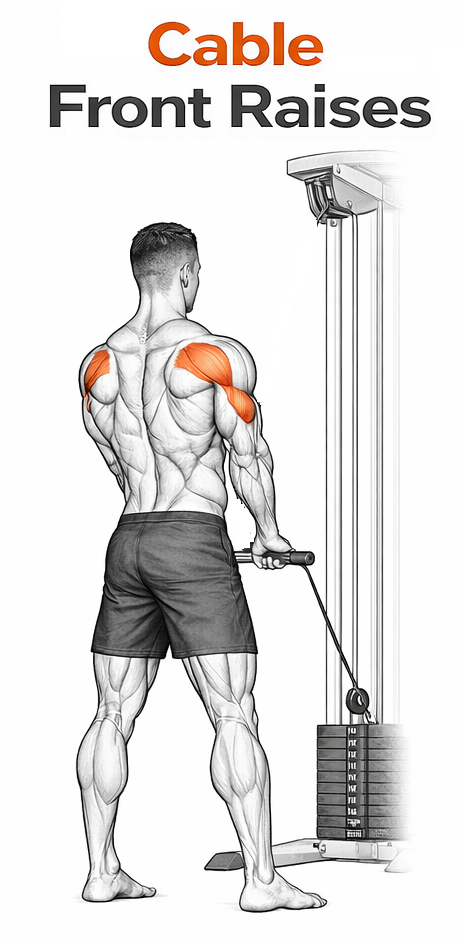
Standing single-arm cable front raise — constant-tension anterior deltoid work that loads the bottom of the range a dumbbell can't.
Level: Beginner
Primary: Shoulder
Movement: Isolation
Type: Strength (Weight Lifting)
Equipment: Cable
Sports: Swimming Volleyball
Target muscles
The anterior deltoid is the prime mover through shoulder flexion. The upper pectoralis major contributes, especially through the lower half of the range. The serratus anterior holds the scapula stable as the arm travels. The biceps and the rotator cuff stabilize the shoulder joint. The cable's pull at the bottom of the rep — when a dumbbell would be at slack — loads the anterior deltoid through a range it doesn't normally see, which is the primary appeal over a dumbbell front raise.
How to perform
Setup
Set a cable to the lowest pulley with a D-handle attachment. Stand with your side or back to the cable — the working arm reaches behind to grip the handle. The handle should be at hip height or just behind the body when you start. Stand tall, feet hip-width apart, trunk braced.
Execution
With a slight bend in the elbow that you'll maintain throughout, raise the working arm straight in front of you to shoulder height. Pause briefly at the top. Lower under control through the same arc back to the starting position behind the body. The torso stays absolutely still — no swinging, no leaning back to launch the arm up. Complete all reps on one side before switching arms. The non-working hand can hold the cable machine for stability.
Common mistakes
- Swinging the torso to assist. The body stays still; the arm does the work.
- Raising the arm higher than shoulder height. Going higher recruits the traps; the front-raise stays at the shoulder.
- Going too heavy. The anterior deltoid is already heavily worked by every pressing lift; this is precision accessory work, not a pressing PR.
- Bending the elbow more during the rep. Maintain the slight bend throughout.
- Leaning forward at the bottom of the rep. The torso stays vertical.
Progressions and regressions
Regress to dumbbell front raises until the pattern is automatic. To progress, work pause front raises (2-second hold at peak), 1-and-a-half reps (full raise, lower halfway, full raise, full lower), or bilateral cable front raises (two cables, one in each hand). Cable Y-raises hit the upper traps and overhead range from a similar setup.
Programming notes
Accessory work, not main lifts. 3 sets of 10-15 reps per side. Once or twice a week. Most lifters get plenty of anterior deltoid stimulus from pressing volume — the front raise is for lifters who want to specifically bring up the front delts or for those whose pressing program is more horizontal than vertical. Pair with lateral raises and rear-delt flyes for a balanced shoulder program.