Box Jumps
Vertical jump onto a box landing in a squat — the classic plyometric for explosive lower-body power.
Level: Foundation
Primary: Quads
Secondary: Glutes
Movement: Compound
Tags: Explosive
Type: Anaerobic Intervals (HIIT / Bootcamp / Circuit) Plyometric
Equipment: Jump Box
Sports: Basketball Football Track and Field Volleyball
Target muscles
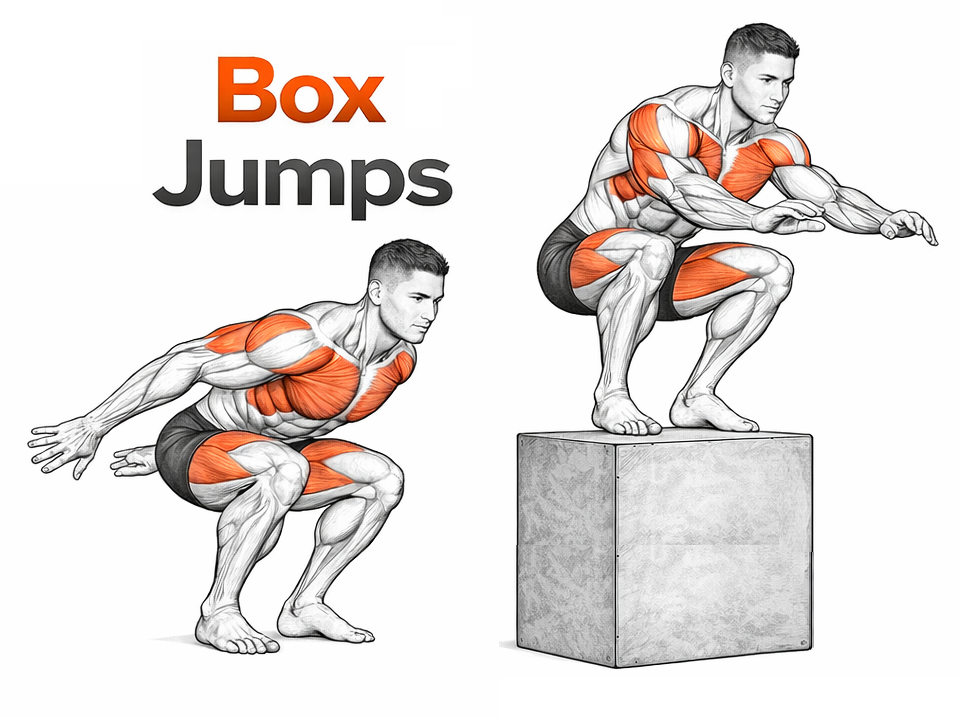
The quadriceps and gluteus maximus drive the explosive jump. The hamstrings and adductors stabilize the landing. The calves and Achilles tendons store and release elastic energy. The trunk muscles brace through the takeoff and landing. The arms swing for momentum. As a plyometric, this is largely a nervous-system training movement — about teaching the lower body to express maximum force quickly — rather than a high-volume conditioning or hypertrophy lift.
How to perform
Setup
Position a sturdy box at a height you can clear safely with good form — for most people that's 18-24 inches; advanced jumpers go higher. Stand facing the box, feet hip-width apart, about a foot away. Arms relaxed at the sides.
Execution
Swing the arms back as you dip into a quarter-squat. Reverse direction explosively — arms swing forward and up as the legs drive off the floor. Jump onto the box, landing softly with both feet at approximately the same time, knees and hips bending to absorb the impact. The landing should be quiet and balanced. Stand tall on the box. Step down — don't jump down. Reset facing the box for the next rep. Step-down protects the knees and Achilles from impact load that doesn't need to be there.
Common mistakes
- Picking a box that's too high. The jump should be challenging but cleanly clearable; injuries happen when fatigue meets a box that's at the limit.
- Tucking the knees toward the chest mid-air to "clear" the box. That's a flexibility expression, not a power expression. Jump high enough to land in a clean partial squat.
- Jumping down off the box. Step down. Repeated drop-landings hammer the knees and Achilles.
- Hard noisy landings. The legs should absorb; quiet landings mean good mechanics.
- Doing them for time when very fatigued. Once landing form deteriorates, stop the set.
Progressions and regressions
Regress to broad jumps (max horizontal distance, soft landing) which teach the same triple extension without the height-of-box challenge. Vertical jumps onto a measured wall mark are another useful intermediate. To progress, increase box height conservatively (no more than 2-3 inches per training block), work the depth jump (add a drop-and-rebound), or do single-leg box jumps for athletic-specific power.
Programming notes
Train fresh, before lower-body strength work or on a separate session. 4-6 sets of 3-5 reps with full recovery (60-90 seconds between sets). Once a week. Quality over volume — a few clean explosive reps beat many fatigued reps. As conditioning, box jumps can be cycled in EMOM formats at sub-maximal heights, but the explosive-power benefit comes from low-rep, high-quality sets.