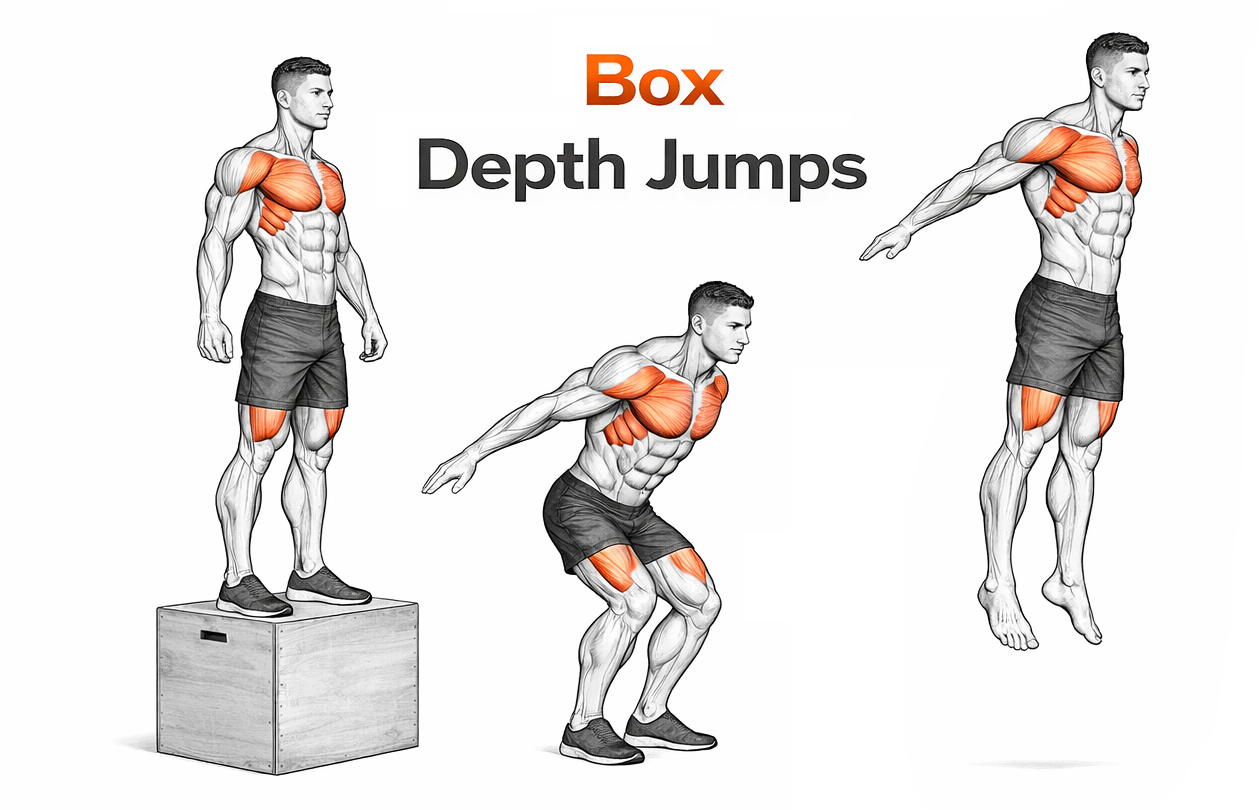
Box Depth Jumps
Drop from a box and immediately rebound into a maximum vertical jump — the gold-standard reactive-strength plyometric.
Level: Intermediate
Primary: Quads
Secondary: Glutes
Movement: Compound
Tags: Explosive
Type: Anaerobic Intervals (HIIT / Bootcamp / Circuit) Plyometric
Equipment: Jump Box
Sports: Basketball Track and Field Volleyball
Target muscles
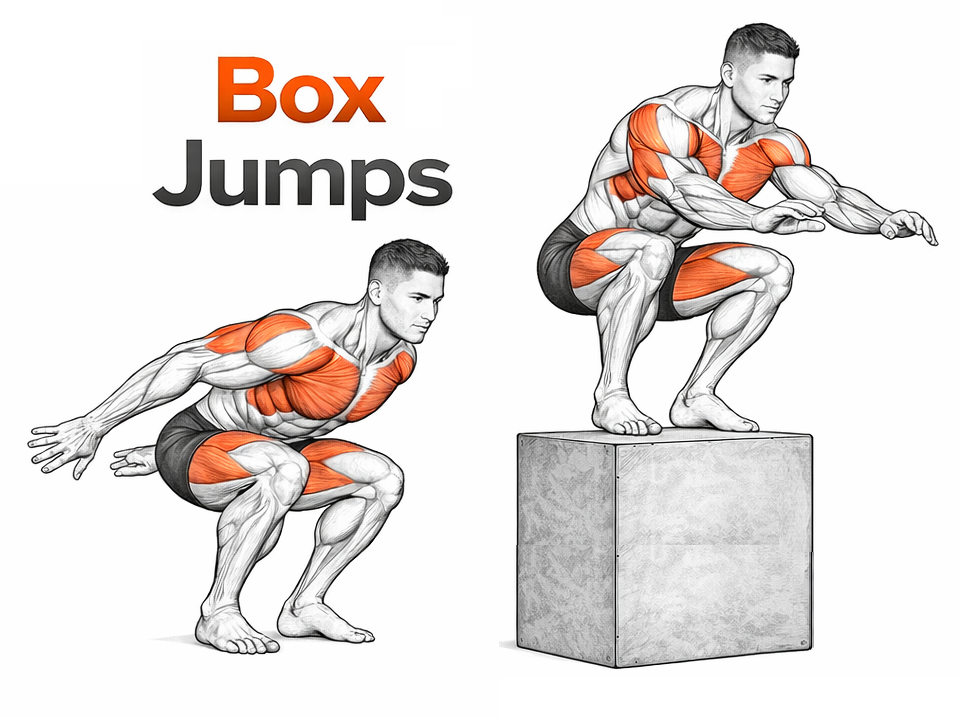
The quadriceps and gluteus maximus do the explosive work — both in the eccentric absorption of the drop and the concentric power of the jump. The hamstrings and adductors stabilize the knees through the contact and rebound. The Achilles tendons store and release elastic energy in the brief ground contact. The cardiovascular system isn't taxed much per rep; this is a nervous-system training movement, not a conditioning movement. Done well, the depth jump teaches the legs to produce maximum force in minimum time — the foundation of athletic explosiveness.
How to perform
Setup
Set a sturdy box at 12-18 inches for beginners, up to 24 inches for advanced. Higher boxes don't train more power — they train more impact absorption, which is a different and harder skill. Stand on top with feet hip-width apart, weight on the mid-foot. Take a breath.
Execution
Step off the edge of the box — don't jump off; step off so you fall vertically rather than forward. Land mid-foot with the knees bending immediately to absorb. As soon as the feet touch the floor, reverse direction and explode straight up into a maximum vertical jump. Land softly from the vertical jump. Step back onto the box and reset. The key metric is ground contact time — it should feel almost instantaneous between landing and rebounding. If you sink into a deep squat before jumping, you've lost the reactive-strength quality and trained something different.
Common mistakes
- Jumping forward off the box instead of stepping off. The landing should be directly below the box.
- Sinking into a deep squat after landing. The contact should be as brief as possible — that's the point.
- Landing flat-footed. Mid-foot landings with the knee and hip absorbing.
- Using a box too tall for the rebound. If you can't bounce up cleanly, the box is too high. Lower it.
- Doing high-volume sets. Depth jumps are nervous-system training: low reps, full recovery, fresh legs only.
Progressions and regressions
Regress to box jumps (jumping up to a box from a stand) until the landing mechanics are clean. Then to box drop squats (drop from the box and land in a squat, no rebound) to learn the absorption phase. From there, the depth jump's reactive rebound. To progress, increase box height conservatively (no faster than 2-3 inches per 2-4 weeks), or add complex pairings (depth jump + box jump back up).
Programming notes
Train fresh, early in the session, on its own day or before lower-body strength work (not after). 3-5 sets of 3-5 reps with full recovery (60-90 seconds between sets). Once a week, never daily. The Achilles and knee tissue load is significant; cumulative fatigue from too much depth-jump volume shows up as tendinopathy. Build a base of strength (1.5x bodyweight squat) before chasing reactive-strength work.