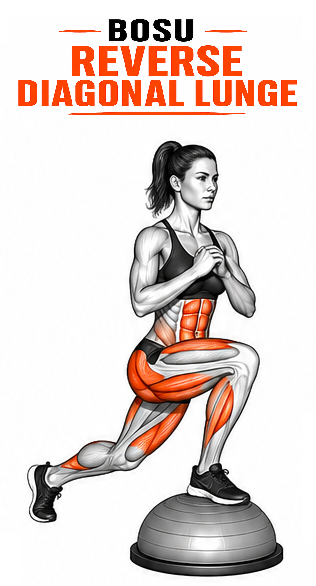
BOSU Reverse Diagonal Lunge
A reverse lunge stepping back on a diagonal off the BOSU, loading the glutes and quads while challenging hip stability across planes.
Level: Advanced
Primary: Quads
Secondary: Abductors Abs Glutes Hamstrings
Movement: Compound
Tags: Balance / Stability Lunge Unilateral
Type: Strength (Weight Lifting)
Equipment: Balance Trainer
Target muscles
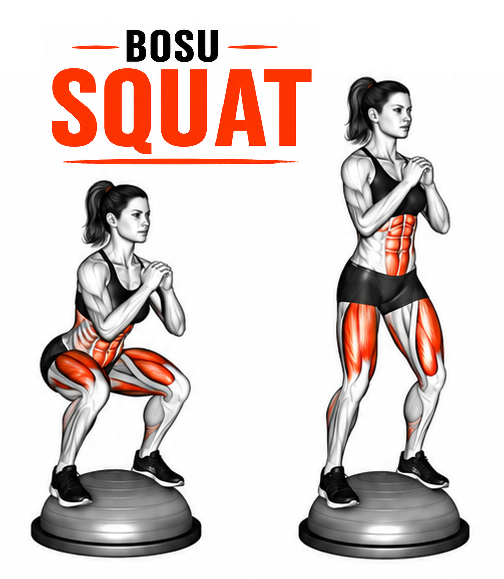
Standing on the dome with one foot, the planted-leg quad and glute carry the load while the hamstrings assist hip extension on the way up. Stepping back on a diagonal adds a frontal-plane element, so the glute medius and hip abductors work to keep the pelvis level and the knee tracking. The ankle and core stabilisers manage the wobble of the dome throughout, making this a true three-dimensional single-leg drill.
How to perform
Setup
Stand with one foot planted on the centre of the BOSU dome and the other foot light on the floor. Stand tall, square the hips, and brace the core to settle the wobble before you move.
Execution
Step the free leg back and across on a diagonal — roughly toward four or eight o'clock — and lower into a lunge, keeping most of the weight on the dome-side leg. Let the dome-side knee bend and track over the foot while the hips stay square. Drive through the dome-side foot to return to standing tall and balanced. The diagonal path means the standing leg resists rotation as well as flexion, so move deliberately. Finish the reps, then switch the standing leg.
Common mistakes
- Letting the standing knee cave inward as the trail leg crosses back.
- Shifting weight onto the back foot instead of loading the dome-side leg.
- Allowing the hips to rotate open rather than staying square through the diagonal.
- Rushing the rep so the dome wobble dictates the movement.
Progressions and regressions
Regress to a straight reverse lunge on the floor, or keep the trail step shallow until the balance settles. Progress by holding a dumbbell or plate, adding a balance pause at the top, or driving the trail knee up after the step back.
Programming notes
Program it as advanced unilateral lower-body work, 2-3 sets of 6-10 reps per side. The multi-plane demand makes it valuable for athletes who cut and rotate, but the instability limits load, so prioritise control. Place it after the main bilateral lift while the stabilisers are fresh.