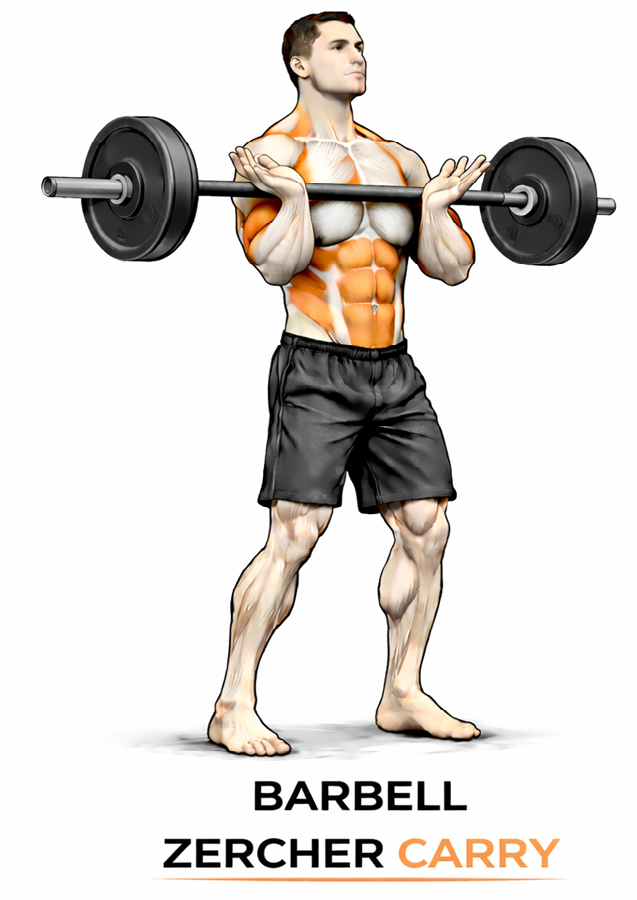
Barbell Zercher Carry
Loaded carry with a barbell held in the crooks of the elbows — extreme upper-back, trunk, and grip demand in a single movement.
Level: Intermediate
Primary: Full Body
Movement: Compound
Tags: Loaded Carry
Type: Functional Fitness (Obstacle & Hybrid) Hybrid Athletic Strength (Weight Lifting)
Equipment: Barbell
Sports: Football Rugby Wrestling
Target muscles
The trapezius (upper and middle), rhomboids, and rear deltoids work isometrically to hold the bar tight against the chest. The biceps brachii are loaded in a held flexion through the entire carry. The trunk muscles — rectus abdominis, obliques, spinal erectors, multifidus — fight continuously to keep the spine neutral against the front-loaded bar. The quadriceps and glutes drive each step. The cardiovascular cost is meaningful at any non-trivial load. As loaded carries go, the Zercher is one of the most demanding per pound.
How to perform
Setup
Set a barbell in a rack at navel height. Pad the bar with a folded towel or a dedicated Zercher pad — the bar in the bare elbow crooks is one of the most uncomfortable things in the gym. Step in and load the bar into the crooks of the elbows by bending the arms underneath. Wrap the forearms across the front of the bar and lock them so the bar can't drop. Squeeze the elbows close to the body. Take a big breath, brace, step away from the rack.
Execution
Walk forward with controlled steps — heel to toe, not shuffling, not sprinting. Keep the torso vertical; the bar will pull you forward continuously, and your job is to fight that pull. Brace each step. The eyes look forward, not down. Travel for the prescribed distance or time. To return the bar, step back to the rack rather than dropping a Zercher-loaded barbell; the descent to the floor is unkind to the lower back.
Common mistakes
- Skipping the bar pad. The bare bar on the elbow crooks is brutal and unnecessary. Always pad.
- Letting the chest drop forward as you walk. Eyes up, ribs over hips.
- Stepping fast or jogging. The carry is a strength endurance lift, not a speed lift. Walk under control.
- Holding the breath through the entire carry. Breathe in short cycles — inhale, brace, exhale.
- Going too heavy on the first session. Start with a load you can carry for 30 seconds without form breaking; build from there.
Progressions and regressions
Regress to farmer's carries (dumbbells or kettlebells in each hand) for an easier introduction to loaded carries with less trunk demand. Then to the goblet carry (single dumbbell or kettlebell at chest) for the front-load pattern. Build the bar-in-elbows position with static holds at moderate loads before walking. To progress, increase load, distance, or duration. The Zercher squat is a related lift that loads the same position dynamically.
Programming notes
Excellent finisher after squats or as part of a conditioning circuit. 3-5 sets of 30-60 seconds of walking, or 20-40 meters per set. Once or twice a week. The trunk demand combines with whatever you've already done in the session, so program it after the main strength work rather than before. Don't program Zercher carries the day before a heavy bench session — the biceps are loaded heavily isometrically and the carryover into a heavy press isn't friendly.