Barbell Back Squats
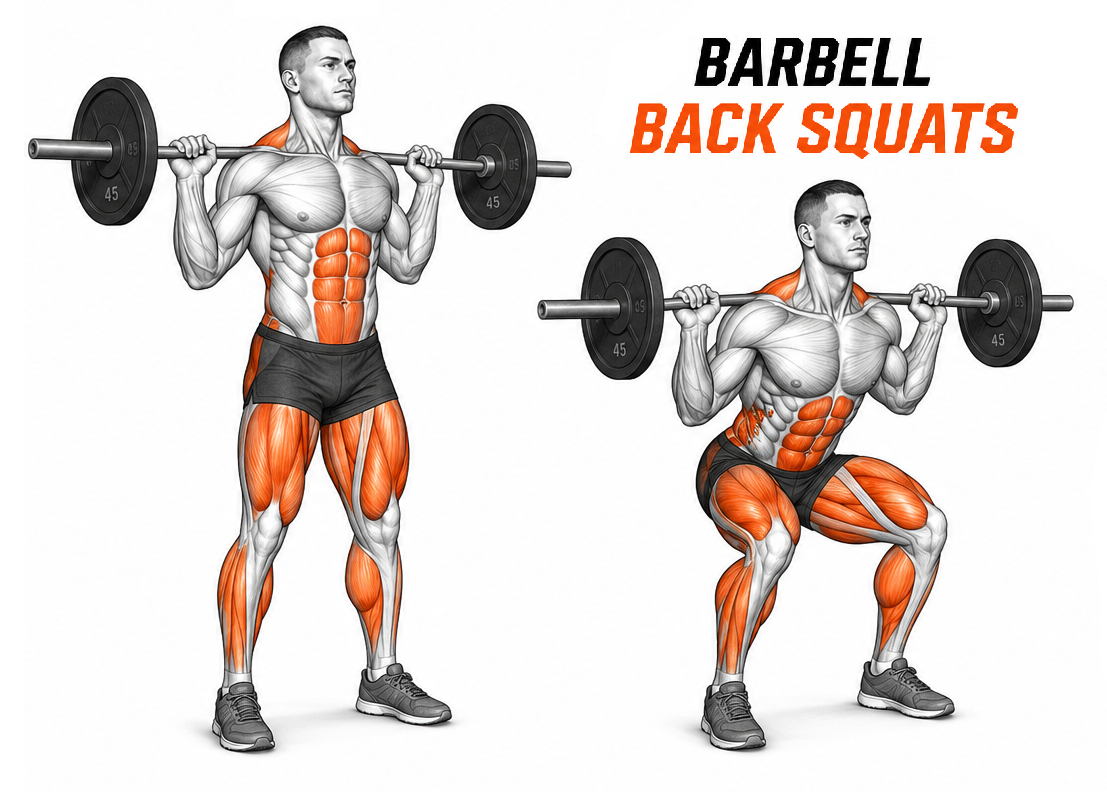
The cornerstone barbell squat — high-bar or low-bar back placement, knees and hips flexing together to drop the hips below the knee crease.
Level: Intermediate
Primary: Quads
Secondary: Glutes Hamstrings
Movement: Compound
Tags: Primary Lift Squat
Type: Strength (Weight Lifting)
Equipment: Barbell Machine
Sports: Basketball Football Rugby Track and Field Volleyball
Target muscles
The quadriceps drive knee extension out of the hole and through the lockout; the gluteus maximus drives hip extension. Hamstrings co-contract to stabilize the knee through the full range and contribute to hip extension as you stand. The spinal erectors, multifidus, and quadratus lumborum work isometrically to keep the trunk rigid against the bar load. With a low-bar position, more of the load shifts to the hips and hamstrings; with a high-bar position, more sits on the quads. Both are honest squats.
How to perform
Setup
Set the rack so the bar sits at sternum height — high enough to unrack with a slight knee bend, low enough that you don't have to tiptoe to clear the J-cups. Step under the bar, plant it on the upper traps (high-bar) or across the rear delts (low-bar), and pull the elbows down to create a tight shelf. Tight grip, chest up, big breath into the belly, brace, unrack, take two clean steps back, set the feet shoulder-width with toes turned out 10-30 degrees.
Execution
Push the hips back slightly and break at the knees and hips simultaneously — neither should move first. Track the knees out over the second toes throughout. Descend to depth (the hip crease passes below the top of the knee). Don't pause unless you mean to. Drive through the whole foot — heel weighted but mid-foot and ball pressing the floor too — and stand by extending the hips and knees together. Exhale through the sticking point or on the way out of the hole, depending on your breathing pattern. One rep.
Common mistakes
- Knees collapsing in on the way up. Cue "spread the floor" or "knees out" actively from the bottom.
- Hips shooting up faster than the bar — you've turned a squat into a stiff-legged good morning. Drive the chest up first.
- Cutting depth as the weight gets heavier. If a heavier set looks shallower than your warm-ups, the weight is wrong, not the depth.
- Looking up at the ceiling. A neutral-to-slightly-down gaze keeps the spine stacked. Eyes on the wall ahead, not on a spot above the rack.
- Holding your breath all the way through every rep on heavy sets. Inhale at the top, brace, descend, drive — exhale near the top of the rep before re-bracing for the next.
Progressions and regressions
Regress with goblet squats or front squats to groove the upright torso and bottom position before loading the back-squat heavily. Box squats — sitting briefly to a target depth — help dial in consistent depth during a learning phase. To progress, add load on a basic linear progression while form holds, then layer in pause squats (3-second pause at depth), tempo squats (3-second descent), and pin squats from below parallel. Once you've got 1.5x bodyweight for clean reps, the meaningful gains come from cycling these variations rather than chasing your raw 1RM weekly.
Programming notes
Squat first in the session, before anything that pre-fatigues the legs or trunk. For strength: 3-5 sets of 3-5 reps, 80-90% of 1RM, two or three sessions per week with at least one heavier and one lighter day. For hypertrophy: 3-5 sets of 6-12 reps. For general fitness: 3 sets of 8-10 at a load you could complete two more reps on. Spinal recovery is real — most people respond best to one heavy squat day and one variation day per week rather than three heavy sessions.