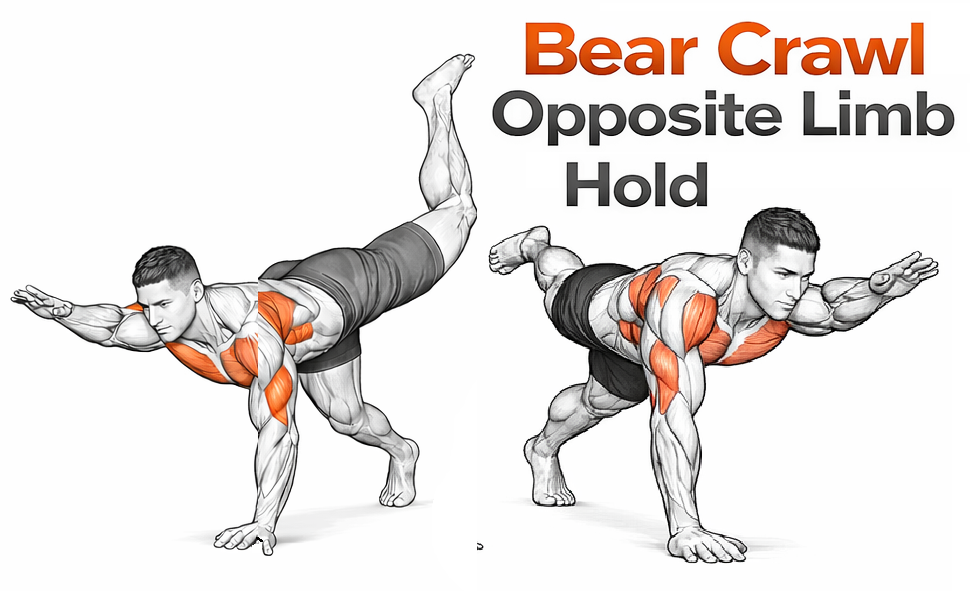
Bear Crawl Opposite Limb Hold
Bear crawl hold with one arm and the opposite leg extended — extreme anti-rotation challenge for the trunk and hips.
Level: Beginner
Primary: Full Body
Secondary: Cardio
Movement: Isolation
Tags: Animal Movement
Type: Anaerobic Intervals (HIIT / Bootcamp / Circuit) Functional Fitness (Obstacle & Hybrid) ISO Primal Movments (Animal Flow-QMT Specifics)
Equipment: Body Weight
Sports: Gymnastics MMA Wrestling
Target muscles
The obliques fire hard to resist rotation through the torso — with one arm and the opposite leg lifted, every body weight pound wants to twist you. The deep core stabilizes the spine. The glute medius of the planted leg and the contralateral shoulder muscles work to keep the hips and shoulders square. The lifted arm's posterior deltoid and rotator cuff hold the shoulder in position. The lifted leg's glute maximus and hamstring hold the hip extension. This is one of the most demanding bear-crawl variations for trunk control.
How to perform
Setup
Start in a bear crawl position — knees hovering one inch off the floor, hands under shoulders, knees under hips, spine flat. Pack the shoulders and brace the trunk. Take a breath.
Execution
Slowly extend one arm forward and the opposite leg back simultaneously, holding both at body-line height. The arm extends to a horizontal line with the body; the leg extends to a horizontal line, hip fully extended. The hips and shoulders stay absolutely square — no twisting toward the lifted side. Hold for the prescribed time. Then carefully return the limbs to the bear crawl position. Switch sides. The transition should be slow and controlled — most failed reps fail during the transitions, not the holds.
Common mistakes
- Letting the hips rotate toward the lifted leg side. Keep the hips square — this is the entire point of the exercise.
- Lifting the arm and leg unevenly. The hand should come up to body height; the leg should rise to hip height.
- Holding the breath. Breathe in controlled cycles.
- Rushing the transitions. Slow movement during the limb extension is where the trunk learns to brace against rotation.
- Going too soon to long holds. Start with 5-10 second holds per side; build to 20-30.
Progressions and regressions
Regress to the basic bear crawl hold (no limbs lifted) until you can hold a clean position for 30 seconds. Then practice slow opposite-limb lifts without holding (lift, return, switch — no static phase). Move to the static hold from there. To progress, lengthen the holds, add a load (a light dumbbell in the lifted hand or a weighted vest), or chain the holds with bear crawl variations.
Programming notes
Excellent trunk and anti-rotation work, especially for athletes whose sports demand rotational stability (martial arts, throwing sports, racket sports). 3 sets of 5-15 seconds per side, two or three times a week. As part of a warm-up, one set of 10 seconds per side primes the trunk for heavier work. Don't program right before a heavy squat or deadlift — fried trunk muscles cost you bracing strength.