Battle Ropes Alternating Waves
The anterior and lateral deltoids pump out-of-phase waves while the forearm grip and pounding heart rate carry the conditioning load.
Level: Foundation
Primary: Shoulder
Secondary: Back - Upper Cardio Forearms
Movement: Compound
Type: Aerobic (Cardio) Anaerobic Intervals (HIIT / Bootcamp / Circuit)
Equipment: Battle Ropes
Target muscles
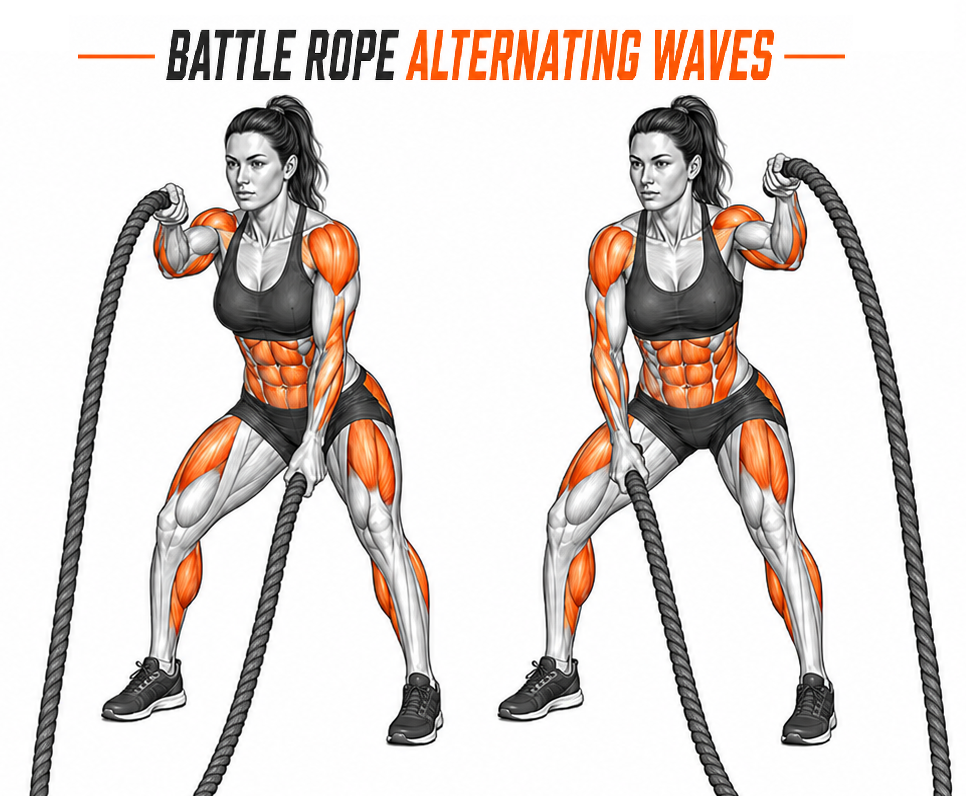
The anterior and lateral deltoids do the bulk of the work, raising and lowering each arm in opposition to send a continuous wave down the rope. The forearm flexors grip hard for the whole interval, and the upper back and traps stabilise the shoulder girdle against the rope's snap. Because both arms never rest at the same time, the heart and lungs are taxed heavily, making the cardiovascular and metabolic demand as much the point as the deltoid work itself.
How to perform
Setup
Anchor the rope around a sturdy post and walk back until there is a slight slope with most of the slack removed. Hold one end in each hand with a neutral grip, thumbs up. Set your feet shoulder-width, soften the knees into a quarter-squat, and hinge slightly at the hips. Brace your trunk so the spine and pelvis stay quiet, set the shoulders down and back, and fix your eyes forward before the first wave.
Execution
Drive one arm up forcefully while the other punches down, then reverse them in a fast, even rhythm so the two ropes make continuous alternating waves. Lead the motion from the shoulders and let the elbows stay relatively soft. Keep the waves tall and uniform all the way to the anchor rather than letting them die halfway. Breathe in a steady cadence and keep the core locked so the power comes from the arms, not from rocking the torso back and forth.
Common mistakes
- Rocking the whole torso up and down to fling the ropes instead of driving cleanly from the shoulders.
- Standing bolt upright with locked knees, which removes the athletic base and tires the lower back.
- Letting the waves shrink to ripples as the interval drags on instead of holding amplitude.
- Gripping with white knuckles from the first second so the forearms gas out before the shoulders do.
Progressions and regressions
Regress by shortening the interval, taking some slack out of the rope, or standing closer to the anchor so the waves are easier to sustain at full height. Progress by lengthening the work bout, moving into a deeper athletic stance, or adding a slight squat pulse with each wave to bring the legs into play. From here you can branch into double waves, slams, and the directional circle variations once the basic alternating rhythm is automatic and the amplitude holds for the whole set.
Programming notes
Use it as a conditioning staple in intervals of 20-40 seconds of hard waves against 20-60 seconds of rest, for 4-8 rounds. It works equally well as a finisher, a station in a circuit, or part of a HIIT block. Keep effort high and amplitude honest rather than padding the clock with weak ripples, and rotate it with slams and circles so the shoulders meet the rope from several angles.