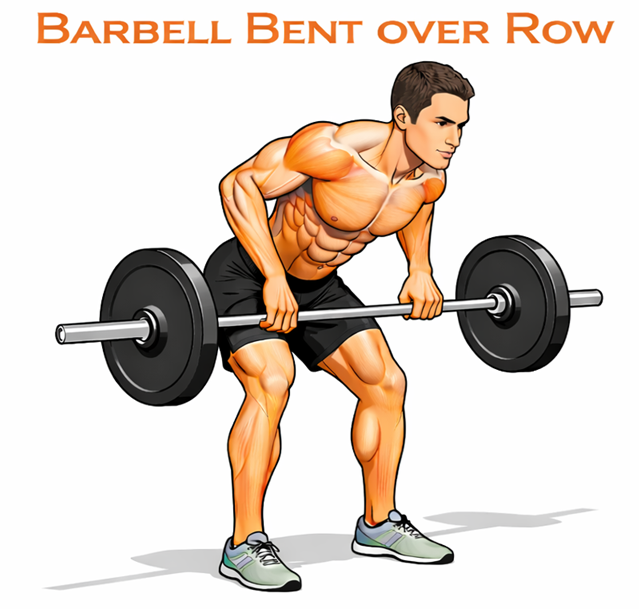
Barbell Bent Over Row
Hinged barbell row pulling the bar to the lower chest — the classic mass-builder for the mid-back, lats, and rear delts.
Level: Intermediate
Primary: Back - Upper
Secondary: Biceps
Movement: Compound
Tags: Primary Lift Pull
Type: Strength (Weight Lifting)
Equipment: Barbell
Sports: Football Rugby Swimming Wrestling
Target muscles
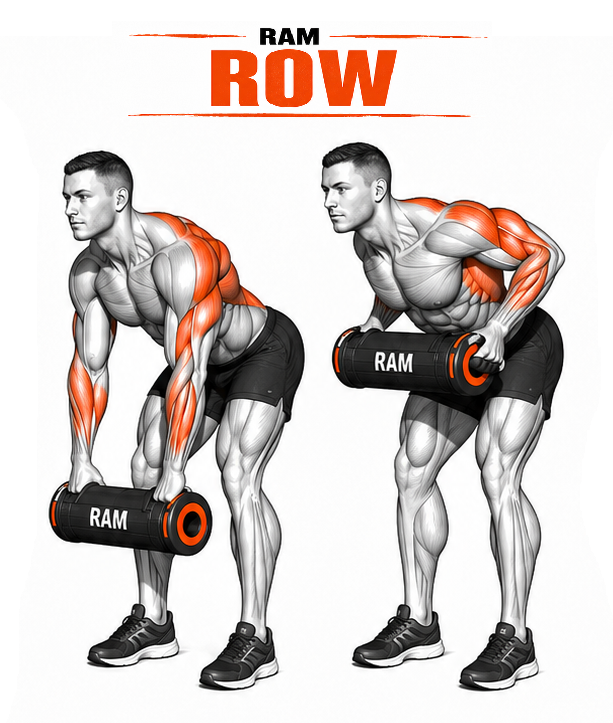
The latissimus dorsi drive the pull from a long, stretched position. The rhomboids and middle trapezius retract the scapulae through the top of the rep. The posterior deltoids contribute meaningfully when the elbows track wide; the biceps brachii, brachialis, and brachioradialis assist at the elbow. The spinal erectors and the glute and hamstring complex work isometrically to maintain the hinge position — this is why a bent-over row often feels like a low-back lift even when the focus is the upper back.
How to perform
Setup
Stand with feet hip-width apart, bar over the mid-foot. Hinge at the hips with a slight knee bend until the torso is roughly 45 degrees from horizontal — closer to parallel for more upper-back emphasis, more upright for lats. Grip the bar slightly outside the legs with a double-overhand grip. Shoulders pulled down and back, chest proud, lower back in a neutral arch. Big breath, brace.
Execution
Pull the bar toward the lower chest or upper abdomen by driving the elbows back and slightly out. Squeeze the shoulder blades together at the top — a hard one-second contraction. Lower the bar under control to a fully stretched position; let the lats lengthen rather than dropping into a slump. Don't yank with the lower back to start the rep, and don't let the torso rise more than a degree or two during the pull — if you're bouncing the torso to move the bar, the load is too heavy. Exhale at the top of each rep.
Common mistakes
- Standing the torso up to use the lower back as a lever. Pick a torso angle and stay there.
- Pulling the bar to the upper chest or chin — this is an upright row, not a bent-over row. Pull to the lower chest or stomach.
- Rounding the lower back at the bottom. Maintain the neutral arch. If you can't, lighten the load or work your hinge first.
- Stopping the rep two inches short of the chest because the weight got heavy. Touch or near-touch every rep, or count it as a fail.
- Using straps before you've earned them. Build the grip first, then add straps for the heaviest sets — not for warm-ups.
Progressions and regressions
Regress with chest-supported rows (Pendlay, T-bar with chest pad, seal row) to remove the lower-back limitation while building back strength. Once the back work is solid, add bent-over rows back in. To progress, cycle in Pendlay rows (bar comes to a dead stop on the floor between reps), Yates rows (more upright torso, underhand grip, more biceps), and snatch-grip rows for an extra rangy stretch. Adding straps lets you out-pull your grip on the heaviest top sets.
Programming notes
Pair bent-over rows with bench press for upper-body balance: 3-4 sets of 6-10 reps, two days a week. Hard sets here build a thicker back than any machine row, but they're systemically taxing — don't program them the day before a heavy deadlift. As an accessory after a deadlift session, drop to lighter loads (4 sets of 10-12) and focus on the upper-back contraction rather than total weight on the bar.